
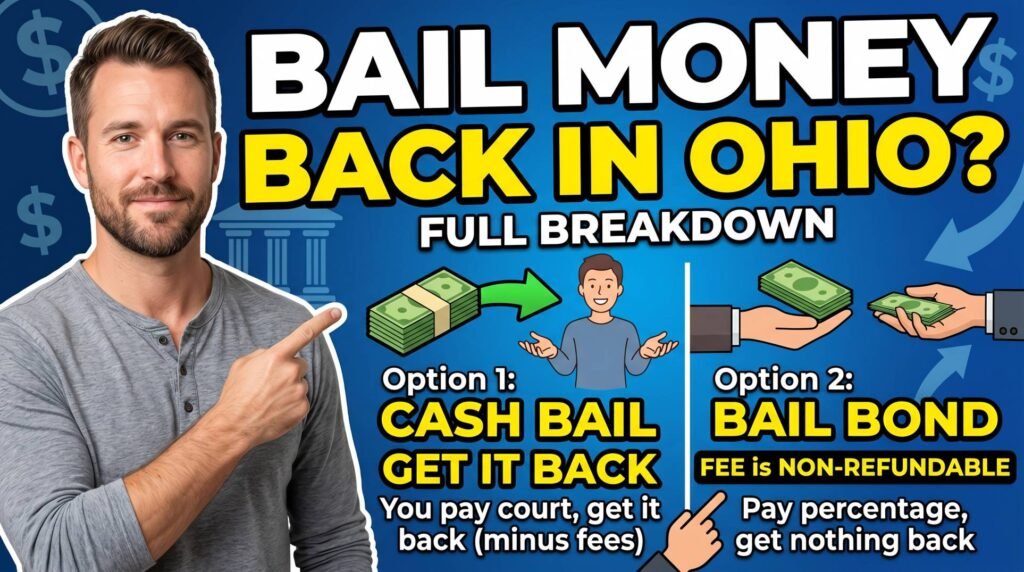
If you’ve ever faced an arrest in Ohio, the question of bail money refund hits hard. Families often pour savings into posting bail, only to wonder: will that cash come back? The short answer is yes—in most cases—but it depends on a few key factors like court compliance and case outcomes. This full breakdown walks you through Ohio’s bail refund rules, timelines, and pitfalls, so you know exactly what to expect and how to maximize your chances of recovery.
Understanding Bail in Ohio: The Basics
Bail serves as a guarantee that the defendant will show up for court. In Ohio, courts set bail amounts based on the crime’s severity, flight risk, and criminal history. Under Ohio Revised Code (ORC) Section 2937.23, bail can be paid in cash, property, or through a surety bond from a bail bondsman.
When you post bail, it’s not a fine—it’s a deposit held by the court until the case resolves. Common amounts range from $1,000 for minor offenses like petty theft to $100,000+ for felonies like drug trafficking. For context, in Lima or Phoenix-area courts (Allen or Putnam Counties), misdemeanor bail often sits around $2,500–$10,000.
Key Point: Bail money isn’t forfeited upfront. It’s returned only after specific conditions are met, which we’ll cover next.
When Do You Get Your Bail Money Back?
Yes, you typically get your full bail amount refunded in Ohio, minus any court fees or fines, if the defendant complies with all court orders. Here’s the step-by-step process:
-
Case Resolution: Bail refunds process after the final court hearing, plea, or trial verdict. This could take weeks (misdemeanors) to months (felonies).
-
No Outstanding Issues: The defendant must attend every hearing, pay any fines, and complete probation terms if applicable.
-
Refund Timeline: Once cleared, the court issues a refund order. Cash refunds arrive via check in 30–90 days; property bonds require appraisal and release.
Real example: In a 2023 Allen County case, a defendant charged with OVI (operating a vehicle impaired) posted $5,000 cash bail. After pleading guilty and paying a $375 fine, the court refunded $4,625 within 45 days.
Problem Solved: Track your case status online via Ohio’s public court portals (e.g., Allen County Clerk of Courts website) to avoid surprises.
Common Scenarios: Will You Get Refunded?
Not every situation leads to a full refund. Let’s break down typical outcomes:
Scenario 1: Defendant Complies Fully
-
Outcome: Full refund minus fees (usually 3–10% for administrative costs).
-
Example: Simple assault charge resolved with dismissal—$10,000 bail returned at 100%.
Scenario 2: Conviction with Fines
-
Outcome: Bail offsets fines first, then refunds the balance.
-
Tip: Pay fines separately to preserve your bail deposit. ORC 2937.28 allows this.
Scenario 3: Failure to Appear (FTA)
-
Outcome: Bail forfeited. Court issues a bench warrant.
-
Fix: Surrender voluntarily or hire a bondsman to reinstate. Forfeiture isn’t permanent—file a motion to set aside under ORC 2937.36 within 10 days of notice.
Scenario 4: Using a Bail Bondsman
-
Outcome: You pay a non-refundable premium (10–15% of bail). The bondsman posts the full amount and gets it back (minus fees) if compliant.
-
Pro Tip: For high bails over $20,000, bondsmen save upfront cash but cost $1,000–$3,000 non-refundable.
| Scenario | Refund Likelihood | Typical Timeline | Potential Deductions |
|---|---|---|---|
| Full Compliance | 95–100% | 30–60 days | Court fees ($50–$500) |
| Fines Owed | 70–90% | 45–90 days | Fine amount |
| FTA | 0% initially | N/A (forfeited) | Full amount + warrant fees |
| Bondsman Used | Premium: 0% | Bond: 90–100% | Service fee (10–15%) |
This table highlights why compliance is crucial—most losses stem from missed hearings.
Factors That Could Delay or Deny Your Refund
Even compliant cases hit snags. Here’s how to avoid them:
-
Administrative Holds: Unpaid child support or restitution liens freeze refunds. Check via Ohio’s Bureau of Criminal Investigation (BCI) records.
-
Court Backlogs: Post-COVID, some Ohio courts (like those in Lima) process refunds in 60+ days. Call the clerk’s office weekly.
-
Property Bonds: Requires clear title and no liens. Delays average 3–6 months.
-
Felony vs. Misdemeanor: Felonies involve more scrutiny; expect 90-day waits.
Problem-Solving Tip: File a “Motion for Refund of Bail” if delayed over 60 days. Include case number, proof of compliance, and ORC 2937.40 citation. Courts must respond.
Case study: A Putnam County family posted $15,000 property bail for a DUI. A lien from an old debt delayed release by 4 months. They resolved it by paying the lien separately, recovering full value.
Cash Bail vs. Alternatives in Ohio
Ohio is shifting from cash bail amid reform debates. Recognizance (ROR) releases defendants without payment for low-risk cases. Pretrial services in larger counties assess flight risk using tools like the ORAS (Ohio Risk Assessment System).
Pros of Cash Bail:
-
Quick release (hours vs. days).
-
Full control over funds.
Cons:
-
Ties up cash.
-
Forfeiture risk.
If bail seems unaffordable, consider:
-
Surety Bonds: Low upfront cost.
-
Collateral Loans: Short-term from credit unions.
-
Pretrial Diversion: For first-timers, avoids bail entirely.
Ohio Supreme Court data shows 70% of defendants regain bail through compliance, proving it’s recoverable with planning.
Steps to Ensure You Get Your Bail Money Back
Follow this checklist to protect your deposit:
-
Document Everything: Keep receipts, hearing notices, and payment proofs.
-
Attend All Dates: Use calendar apps with reminders; reschedule only via court.
-
Communicate with Court: Update address/phone with the clerk.
-
Monitor Status: Use Ohio Courts’ e-filing portal or call 419-228-1837 (Allen County example).
-
Seek Help Early: If FTA occurs, act fast—Ohio allows remission of up to 75% of forfeited bail for good cause (ORC 2937.39).
-
Consult Experts: Bail bondsmen handle paperwork, reducing errors.
By front-loading these habits, families in Ohio recover funds 90%+ of the time.
Myths About Bail Refunds Debunked
-
Myth 1: Bail is a fine. Fact: It’s a deposit—fines come separately.
-
Myth 2: Bondsman fees are refundable. Fact: Premiums cover risk; non-refundable.
-
Myth 3: Refunds are instant. Fact: Processing takes 30–90 days minimum.
These misconceptions cost Ohioans thousands yearly. Armed with facts, you avoid them.
Why Timing Matters: Act Fast on Bail Issues
Delays compound stress. If arrested in Ohio, post bail within 48 hours for fastest release. For forfeitures, file motions promptly—late petitions get denied.
In high-stakes cases (e.g., felonious assault), professional help prevents total loss. Local stats from Ohio Department of Rehabilitation show 15% of bails forfeit due to FTAs, often fixable with quick intervention.
Final Thoughts: Secure Your Refund with Confidence
Getting bail money back in Ohio boils down to compliance, documentation, and timely action. Most people recover their full deposit (minus minor fees) by following court rules. Understand your options—cash, bonds, or alternatives—and stay proactive.
Facing a bail situation in the Phoenix or Lima, Ohio area? Contact Allstate Bail Bonds at 419-765-0861 for fast, reliable service. We guide you through posting, compliance, and recovery, minimizing risks and stress. Available 24/7—call today to get your loved one home and your money back.
