
When someone is arrested in Ohio, one of the first questions families usually ask is: “When will the court decide bail?” Another common question is whether an initial appearance and an arraignment are the same thing.
They are not necessarily the same proceeding.
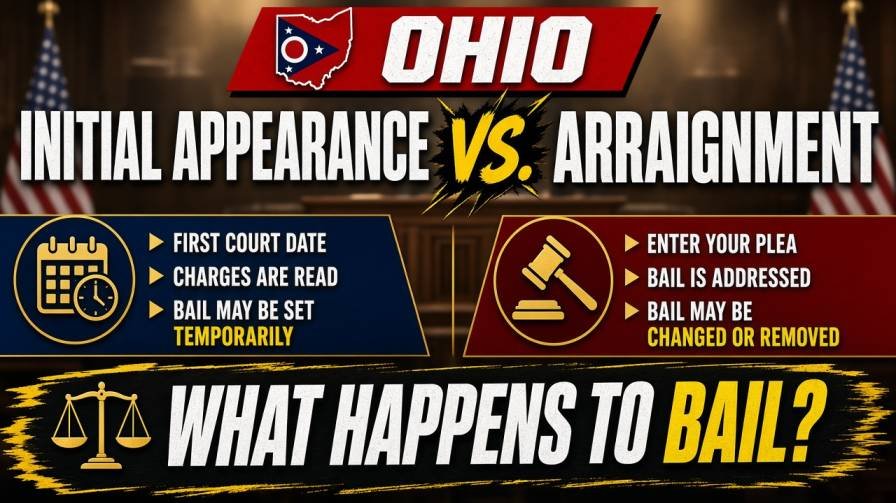
An initial appearance generally occurs early in the criminal court process and gives the defendant important information about the charge, legal rights, and the conditions for release. An arraignment is a later procedural step in which the defendant is formally called upon to enter a plea to the charge.
Understanding the difference can make the process less confusing, especially when a person is trying to determine whether they can be released from jail, whether bail can change, or when a family member should contact a bail bond agency.
Ohio law also provides specific rules concerning pretrial release. Courts generally must consider the least restrictive conditions that will reasonably assure the defendant appears in court, protect people and the community, and prevent obstruction of the criminal justice process.
What Is an Initial Appearance in Ohio?
An initial appearance is one of the first court proceedings after an arrest.
During this stage, the court addresses fundamental matters concerning the defendant and the case. The defendant is generally informed about the nature of the charge and important legal rights, including the right to counsel.
For a felony case that has not already proceeded by indictment, the defendant may also have a right to a preliminary hearing concerning probable cause.
The initial appearance is also important because bail and pretrial release can be addressed at this stage.
Ohio law requires a person who has been arrested and has not been released on bail to be brought before a judicial officer for an initial bail hearing no later than the second court day following the arrest. The bail hearing may be combined with the initial appearance.
This means families should not assume that the first court proceeding will always be called exactly the same thing in every Ohio court. Local court procedures can affect how hearings are scheduled and conducted.
What Happens to Bail at an Initial Appearance?
One of the most important issues at an initial appearance can be the defendant’s release from custody.
Ohio courts can use different forms and conditions of pretrial release. Depending on the circumstances, a defendant may potentially be released on personal recognizance, an unsecured bond, a cash deposit, a surety bond, or another form of release authorized by law.
The court does not simply look at one factor when determining appropriate release conditions.
Ohio law identifies several considerations, including:
- The nature and circumstances of the alleged offense
- Whether a weapon was involved or accessible
- The weight of the evidence
- The defendant’s identity
- Family ties and employment
- Financial resources
- Criminal history
- Previous court appearances
- Whether the person has previously attempted to avoid prosecution
- Whether the person is already on probation, parole, post-release control, bail, or another court-ordered status
- Other factors related to public safety and appearance in court
The court may also impose non-financial conditions of release. These can include travel restrictions, electronic monitoring, house arrest, restrictions on contact with alleged victims or witnesses, supervision, treatment requirements, or other conditions reasonably necessary to address appearance and safety concerns.
What Is an Arraignment in Ohio?
An arraignment is a different part of the criminal process.
Under Ohio Criminal Rule 10, an arraignment generally takes place in open court. The indictment, information, or complaint is read to the defendant, or the substance of the charge is stated, and the defendant is called upon to enter a plea. The defendant can waive the reading of the charging document.
The three basic plea possibilities are generally:
Guilty: The defendant admits the offense.
Not guilty: The defendant contests the charge, and the case continues through the criminal court process.
No contest: The defendant does not admit guilt but does not contest the factual allegations in the same manner as a not-guilty plea. The legal consequences of a no-contest plea can be significant, so defendants should discuss the choice with an attorney.
An arraignment is therefore primarily concerned with the formal charge and plea.
However, bail can still be relevant at or around an arraignment.
Initial Appearance vs. Arraignment: The Main Difference
The simplest way to understand the difference is to look at the purpose of each proceeding.
| Initial Appearance | Arraignment |
|---|---|
| Occurs early after arrest | Formal stage of the criminal case |
| Defendant is informed of the charge and rights | Charge is formally presented |
| Bail or release conditions may be addressed | Defendant is called upon to enter a plea |
| Counsel and preliminary hearing rights may be addressed | Defendant receives or acknowledges the charging document |
| Focuses heavily on early custody and release issues | Focuses heavily on the formal plea |
These proceedings can sometimes happen close together or be handled in ways that vary by court and case. That is why someone facing an Ohio criminal charge should pay attention to the actual court notice and instructions rather than relying only on terminology.
Can Bail Change After the Initial Appearance?
Yes.
A bail amount or release conditions established early in a case are not necessarily permanent.
Ohio law allows a judicial officer to modify the types, amounts, or conditions of bail when the circumstances justify a change. Depending on the circumstances, conditions can be increased, changed, reduced, or eliminated.
For example, a defendant’s situation may change if:
- The court receives new information
- The defendant obtains legal representation
- A previous condition becomes unnecessary
- The defendant demonstrates stronger ties to the community
- There is a concern about failure to appear
- New safety concerns arise
- The prosecution requests a change
- The defense requests a modification
A person should never assume that a previously established bond can simply be ignored because the case has moved to another hearing.
Can Someone Be Denied Bail in Ohio?
In certain serious cases, Ohio law permits the court to consider detention without bail.
Ohio Revised Code Section 2937.222 identifies specific serious offenses for which a hearing may be held to determine whether bail should be denied. These include certain aggravated murder, murder, first- or second-degree felony, certain felony OVI, and other specified offenses.
The requirements for denying bail under that statute are substantial. The judge must make the findings required by law, including findings concerning the evidence and whether the defendant presents a substantial risk of serious physical harm and whether any release conditions could reasonably assure safety.
This is one reason it is important not to assume that every Ohio arrest follows the same bail procedure.
What Types of Bail Can Be Used in Ohio?
Ohio law recognizes several forms of bail.
Depending on the circumstances and court order, release may involve:
Personal Recognizance
A defendant may be released based on a promise to appear and comply with court requirements, without posting a traditional financial bond.
Unsecured Bail Bond
An unsecured bond can involve a financial obligation without requiring the defendant to deposit the full amount before release.
Cash Bail
Cash can be deposited as required by the court.
Surety Bond
A surety bond can involve a licensed bail bond company providing the financial guarantee required for release, subject to applicable Ohio law and the court’s order.
Ohio law specifically identifies unsecured bail bonds, certain 10% cash deposits, surety bonds, real estate or securities when legally permitted, and cash as potential forms of bail.
The exact option available depends on the court order, the type of case, and the applicable rules.
What Happens If the Defendant Misses Court?
Posting bail does not eliminate the defendant’s responsibility to appear in court.
A defendant must comply with the conditions imposed by the court.
Ohio law provides that a failure to appear can result in consequences, including potential forfeiture of bail. A breach of release conditions can also result in the court changing the bail or other conditions.
This is why anyone released on bond should keep track of every court date and comply with all conditions imposed by the court.
If there is confusion about a court date, the defendant or their attorney should contact the appropriate court or legal representative rather than simply failing to appear.
Does Bail Automatically End After an Arraignment?
Not necessarily.
The status of bail depends on the court’s orders and the progress of the case.
Ohio law provides rules governing when bail may be discharged and released. Generally, the treatment of deposited bail can depend on whether the defendant complied with the terms of release and how the criminal case was resolved.
Therefore, an arraignment does not automatically mean that a defendant’s bond disappears, increases, decreases, or ends.
The specific court order controls.
What Should You Do If Someone Is Still in Jail?
If a family member or friend has been arrested and remains in custody, start by obtaining accurate information.
Try to confirm:
- The defendant’s full legal name
- The jail where the person is being held
- The criminal charge
- The court handling the case
- The case or booking number, if available
- The current bail amount
- Whether there are additional release conditions
- The date and time of the next court appearance
Do not rely solely on information from social media or secondhand conversations.
If the court has already set a bond and a surety bond is permitted, a licensed bail bond professional can explain the bond process and the information needed to begin the release process.
It is also important to understand that a bail bond does not determine whether someone is guilty or innocent. Bail concerns pretrial release and appearance in court. The criminal case itself is a separate legal matter.
Initial Appearance or Arraignment: Which One Matters More for Bail?
For someone waiting in jail, the most important issue is usually not the name of the hearing but what the court has ordered regarding release.
An initial appearance can be particularly important because bail and release conditions may be addressed early in the case.
An arraignment is important because it formally addresses the criminal charge and plea.
In some cases, these proceedings may occur separately. In others, procedures may be combined or occur close together depending on the court and circumstances.
If the bail amount is too high for the defendant or family to pay directly, the family may need to determine whether a surety bond is available and whether working with a licensed bail bond agency is appropriate.
Frequently Asked Questions
Can bail be lowered after an arraignment?
Potentially, yes. Ohio law permits courts to modify bail and release conditions when the circumstances justify a change. The appropriate procedure depends on the case and court.
Does an initial appearance mean the defendant is going to trial?
No. An initial appearance is an early stage of the criminal process. It does not mean the defendant has been found guilty or that a trial is occurring.
Is an arraignment the same as a bond hearing?
No. An arraignment primarily concerns the formal charge and the defendant’s plea. Bail or release issues may also be addressed during the broader court process, but the two concepts are not identical.
Can someone be released without paying cash bail?
Potentially. Ohio law provides for different forms and conditions of pretrial release, including personal recognizance and unsecured bail in appropriate circumstances.
What happens if someone violates a condition of bail?
The court may modify the release conditions, and violations can have additional legal consequences. A defendant should take every condition of release seriously.
Final Thoughts
The difference between an Ohio initial appearance and an arraignment can be confusing, particularly when a family is trying to get a loved one released from jail.
The initial appearance generally deals with the early stages of the case, including notice of the charge, important rights, and potentially bail or other conditions of release. The arraignment is primarily the formal proceeding where the defendant is called upon to enter a plea.
Most importantly, bail is determined by the court, and the amount and conditions can depend on the circumstances of the case. Ohio law emphasizes release conditions that are reasonably designed to assure court appearance and protect people and the community, while also allowing courts to impose financial and non-financial conditions when appropriate.
If you or a family member has an Ohio bail question, it is important to obtain the current court and jail information before making decisions about release.
For help understanding the bail bond process, you can contact Allstate Bail Bonds at 419-765-0861. A bail bond professional can explain the available bonding process and what information may be needed to move forward.
Important: This article is provided for general educational information and is not legal advice. Ohio criminal procedure and bail requirements can vary depending on the charges, court, and circumstances of an individual case. For legal advice about a specific criminal case, speak with a qualified Ohio attorney.
