

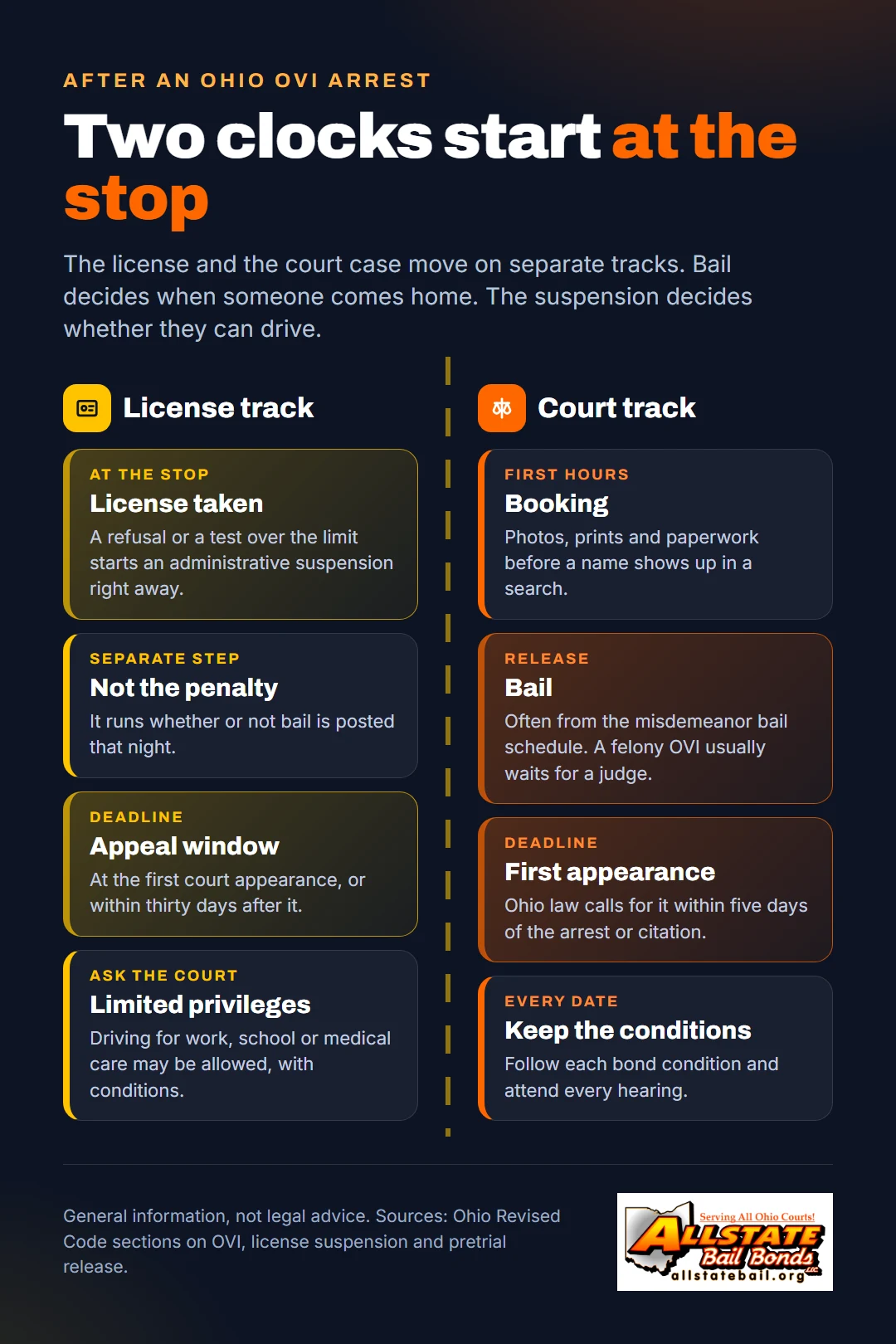
Quick answer: after an OVI arrest in Ohio, two things happen at once. The criminal case starts, with booking, bail and a first court appearance that Ohio law calls for within five days. If the driver refused the test or tested over the limit, a separate administrative license suspension also starts on the spot. Bail decides when the person comes home. The suspension decides whether they can drive once they do. A bail bond helps with the first part, and knowing the deadlines helps with the second.
Most people know the word “bail”. Far fewer know that an OVI arrest comes with a second process attached to the driver’s license, with its own short deadline. Families tend to focus on getting someone released and only later find out the license side has been running the whole time. This guide takes both tracks in order, in plain words, so you know what to ask and when.
In this guide
- OVI in Ohio, in plain words
- The first hours after the stop
- The license track: the administrative suspension
- The court track: how bail works on an OVI
- The first court date: within five days
- How a bail bond helps, and what to have ready
- Mistakes that make an OVI harder
- Frequently asked questions
OVI in Ohio, in plain words
OVI stands for operating a vehicle under the influence of alcohol, a drug of abuse, or a combination of them. The offense is defined in Ohio Revised Code 4511.19. Many people still call it DUI or drunk driving, and you will hear all three.
A first OVI is normally a misdemeanor. The charge becomes a felony when the person has several earlier OVI offenses within a set look-back period, or any earlier felony OVI. Whether a charge is a misdemeanor or a felony matters for bail, because a misdemeanor can often be handled from the court’s bail schedule, while a felony usually waits for a judge.
The first hours after the stop
The order is usually the same, though every county runs its own facility:
- The stop and the test. The officer asks for a chemical test such as a breath test. The driver may take it or refuse.
- The license is taken. After a refusal or a result over the legal limit, Ohio law has the officer seize the license and tell the driver the suspension starts immediately (R.C. 4511.192). The warning is read from BMV form 2255.
- The vehicle. It may be towed. If the driver has a recent prior OVI, the law allows the vehicle to be seized, and the court may later order it immobilized (R.C. 4511.195).
- Booking. Photos, fingerprints, property and paperwork. A name may not appear on an inmate search until this is finished.
- Bail. Either the bail schedule applies or the person waits to see a judge. More on that below.
Some facilities also wait until a person no longer appears impaired before releasing them. That is a local practice, not a statewide rule, so ask the facility how it handles it. If you are the one making calls, our list of questions to ask the jail works well here too.
The license track: the administrative suspension
The administrative license suspension, or ALS, is not the punishment for the OVI charge. It is a separate step that starts at the stop, and it runs whether or not anyone is released on bail that night. The driver leaves without the license.
The suspension can be appealed. Under R.C. 4511.197 the appeal can be made at the initial appearance or within 30 days after it. Ohio courts have treated a late appeal as one they cannot hear, so this is the deadline to write down first.
A court may also grant limited driving privileges during a suspension, for things such as work, school or medical care (R.C. 4510.021). There can be a waiting period, and the court can attach conditions such as an ignition interlock or restricted plates (R.C. 4503.231). Whether to appeal, and whether to ask for privileges, are questions for a defense attorney.
The court track: how bail works on an OVI
Ohio’s pretrial release law, R.C. 2937.011, has every court adopt a bail schedule for misdemeanors, including traffic offenses, so people can be considered for release before their first appearance. For a typical first OVI, that schedule is often where the bail amount comes from. The facility can tell you the amount and how it is accepted.
If the schedule does not cover the case, for example a felony OVI, the person waits for a judge. The same law sets the outer limit for that initial bail hearing at the second court day after the arrest. Weekends and court holidays are not court days, so an arrest late on a Friday can mean a longer wait.
When bail is set, there are usually three ways forward:
- Own recognizance: release on a promise to appear, with conditions, and no money posted.
- Cash bail: the full amount is paid to the court and held until the case ends.
- A surety bond: a licensed bail agent posts the bond, so the family does not pay the full amount up front.
Release can come with conditions, and a judge decides what they are. Read them, keep a copy, and follow every one. Breaking a condition can put the person back in custody.
The first court date: within five days
OVI cases move quickly at the start. Under R.C. 4511.196, the initial appearance on an OVI charge is to be held within five days of the arrest or the citation. That is where the charge is read, a plea is entered, the license suspension can be appealed, and bail and its conditions can be reviewed.
Put the date in every phone in the house. If the person needs a ride because the license was taken, plan it now. A missed first appearance can lead to a warrant and the loss of the bond.
How a bail bond helps, and what to have ready
A bail bondsman cannot change the charge, the suspension or the court’s decisions. What a good one does is take the release part off your plate: verifying where the person is held and how much the bail is, explaining cash and surety options and what each one means for you, and then handling the paperwork and posting the bond once bail is set.
Have this ready when you call:
- the person’s full legal name and date of birth;
- where the stop happened, and the facility if you know it;
- the charge, and whether anyone said it is a felony;
- the bail amount and the court, if you already have them;
- any earlier OVI, since that can change how the case is handled;
- your own name and a number where you can be reached.
In Ohio, surety bail bond agents are licensed through the Ohio Department of Insurance. Ask for a name and license, and ask what you are signing. If you will be the co-signer, read what a cosigner actually agrees to first.
Mistakes that make an OVI harder
- Driving home after release. If the license was suspended, posting bail does not restore it. Driving can lead to a new charge, which our guide to driving under suspension in Ohio explains.
- Letting the 30 days run out. The window to appeal the suspension starts at the initial appearance and closes 30 days after it.
- Missing the first appearance. It comes fast, often within the same week.
- Ignoring bond conditions. Treat them as seriously as the court date.
- Talking about the case on facility phones. Save the details for the defense attorney.
For everything else that happens on day one, see what families should know during the first 24 hours after an Ohio arrest.
Frequently asked questions
Can you get out on bail after a first-offense OVI in Ohio?
Usually there is a path to release, but the details depend on the court. A first OVI is normally a misdemeanor, and Ohio law has every court set a bail schedule for misdemeanors, traffic offenses included, so a person can be considered for release before the first court appearance. The facility will tell you the amount and how it can be paid.
How long will someone be held after an OVI arrest?
No one can promise a time. It depends on booking, whether bail comes from the schedule or a judge, and the facility’s own practice. Some facilities will not release a person who still appears impaired, which is a local practice rather than a statewide rule. If a judge has to set bail, R.C. 2937.011 sets the outer limit for that hearing at the second court day after the arrest.
What happens if you refuse the breath test in Ohio?
A refusal leads to an administrative license suspension that starts right away, and the officer takes the license. The suspension is handled separately from the OVI charge itself. A defense attorney can explain what a refusal means for the rest of the case.
How long do you have to appeal an administrative license suspension?
Under R.C. 4511.197 the appeal can be made at the initial appearance or within 30 days after it. Courts have treated a late appeal as one they cannot hear, so mark the date and confirm the deadline with the court or an attorney.
Can I drive after posting bail on an OVI?
Posting bail does not undo a license suspension. If the license was suspended, driving anyway can lead to a new driving-under-suspension charge. Ask the court about limited driving privileges instead, and follow every condition of the bond.
Is OVI the same as DUI?
In everyday speech, yes. Ohio law uses the term OVI, operating a vehicle under the influence, and it covers alcohol as well as drugs. People still search for DUI, so you will see both terms.
Call us after an OVI arrest, at any hour
Allstate Bail Bonds serves all Ohio courts at any hour, 365 days a year, including all holidays. A licensed local bail bondsman can verify the detention location and bail amount, explain your options, and handle the paperwork and bond posting once bail is set. Find your nearest office on our Ohio locations page, including Bucyrus, Lima, Findlay and Canton.
About the author: Allstate Bail Bonds has served Ohio courts since 2007. The company is owned by Drew Evans, a licensed Ohio bail agent (license #724711). This article is general information for families, not legal advice. OVI law has detailed rules and exceptions, and courts and facilities differ, so confirm deadlines with the court and consult a defense attorney about your specific case. Last reviewed November 2026.
Sources: Ohio Revised Code 4511.19 (OVI), 4511.191 and 4511.192 (implied consent and license seizure), 4511.195 (vehicle seizure), 4511.196 (initial appearance), 4511.197 (suspension appeal), 2937.011 (pretrial release), 4510.021 (limited driving privileges), 4503.231 (restricted plates); Ohio Bureau of Motor Vehicles; Ohio Department of Insurance.
