

Quick answer: in Ohio, robbery is a theft offense with force, a threat or harm added, and it is always a felony. That means bail is normally set by a judge instead of being read from a bail schedule, at a hearing held no later than the second court day after the arrest. Once the judge sets bail, it can be paid in cash or posted through a licensed bail agent as a surety bond. The facility then completes its own release steps, and the person leaves with conditions to follow.
Families are often surprised by the word “robbery”, because what happened may look like shoplifting that went wrong. This guide explains where that line sits and then walks through the release process in the order it happens, so you know what each step is waiting on.
In this guide
- Where theft ends and robbery begins
- The three levels of the charge
- The release process, step by step
- What the judge decides at the bail hearing
- After the bond is posted
- How a bail bond helps, and what to have ready
- What to avoid while the case is open
- Frequently asked questions
Where theft ends and robbery begins
Ohio defines robbery in Revised Code 2911.02. It starts with a theft offense, or an attempt at one. What changes the charge is what happens during the theft or while fleeing right after it: using or threatening force against another person, threatening or causing physical harm, or having a deadly weapon.
The “fleeing immediately after” part is the one people miss. Pushing past an employee at the door, or pulling away from someone trying to stop you, can be enough for prosecutors to charge robbery instead of theft. Whether the facts really support that is a question for the defense attorney. For the family, the point is that the charge on the paperwork is a felony, and the release process follows the felony track.
The three levels of the charge
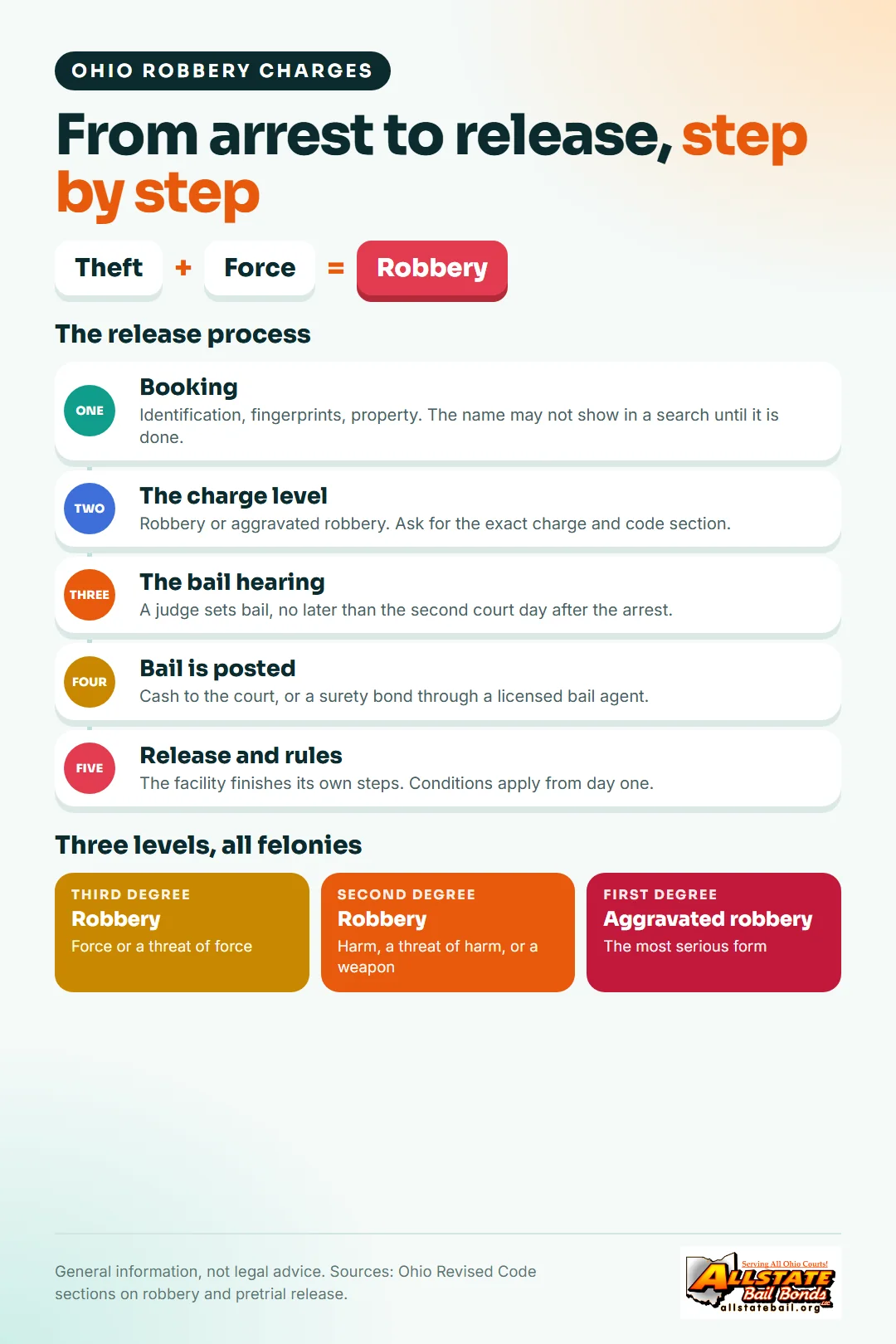
| Charge | In plain words | Level |
|---|---|---|
| Robbery (R.C. 2911.02) | A theft offense with the use or threat of force | Third-degree felony |
| Robbery (R.C. 2911.02) | A theft offense with physical harm, a threat of harm, or a deadly weapon on the person | Second-degree felony |
| Aggravated robbery (R.C. 2911.01) | The most serious form, such as a displayed weapon or serious physical harm | First-degree felony |
Ask for the exact charge and the code section. “Robbery” and “aggravated robbery” are different offenses, and the level is one of the first things a judge looks at.
The release process, step by step
- Booking. Identification, fingerprints, photographs and property. A name may not show on an inmate search until booking is finished.
- The charge is filed. The complaint names the offense and its level. This is when you can ask the facility or the clerk for the exact charge.
- The bail hearing. Ohio’s pretrial release law, R.C. 2937.011, has each court keep a bail schedule for misdemeanors. A felony such as robbery normally falls outside it, so the person waits for a judge. The same law calls for the initial bail hearing no later than the second court day after the arrest.
- Bail is posted. Once the judge sets the type and amount, the family can pay cash bail to the court or work with a licensed bail agent on a surety bond.
- The facility releases the person. After the bond is posted the facility completes its own paperwork and checks, including for holds from other courts.
Each step waits on a different office: the facility, the clerk, the judge, then the facility again. Knowing which office you are waiting on tells you who to call. Our list of questions to ask the jail helps with steps one and two.
What the judge decides at the bail hearing
The judge decides three things: the type of bail, the amount, and the conditions. Judges typically weigh how serious the charge is along with the person’s record, ties to the community and history of coming to court. In the most serious felony cases a prosecutor can also ask the court to hold a person without bail; our article on when bail can be denied in Ohio explains that situation.
When bail is set, there are usually three ways forward:
- Own recognizance or an unsecured bond: release on a promise to appear, with conditions, and no money posted up front.
- Cash bail: the amount the court requires is paid to the court and held until the case ends.
- A surety bond: a licensed bail agent posts the bond, so the family does not pay the full amount up front.
Nobody outside the court can promise what a judge will decide.
After the bond is posted
Posting the bond is not the same moment as walking out. The facility finishes its release steps first, and nobody can promise how long that takes. If another court has a hold on the person, a bond on the robbery case does not clear it.
Release on a robbery charge comes with conditions. They can include staying away from the alleged victim, the business or the location, checking in as ordered, and appearing at every court date. Get them in writing, read them together, and keep a copy where everyone in the house can find it. Breaking a condition can put the person back in custody.
How a bail bond helps, and what to have ready
A bail bondsman cannot change the charge, move the hearing or influence the judge. What a good one does is carry the release work: verifying where the person is held and whether bail has been set, explaining the cash and surety options and what each means for you, and handling the paperwork and posting the bond once bail is set.
Have this ready when you call:
- the person’s full legal name and date of birth;
- the county and the facility, if you know it;
- the exact charge and code section;
- the court and the hearing time, or the bail amount if it is already set;
- whether any other court has a hold;
- your own name and a number where you can be reached.
In Ohio, surety bail bond agents are licensed through the Ohio Department of Insurance. Ask for a name and a license, and ask what you are signing. If you will be the co-signer, read what a cosigner actually agrees to first.
What to avoid while the case is open
- Going back to the store or the location. Even to explain, it can break a stay-away condition.
- Contacting the employee, the owner or witnesses. All contact goes through the defense attorney.
- Talking through the case on facility phones. Those calls are usually recorded.
- Calling it “just shoplifting” to the court or the facility. Use the charge as it is written, and leave the argument to the attorney.
- Missing a court date. A missed appearance can lead to a warrant and the loss of the bond.
Related guides: bail bonds for burglary charges in Ohio and the first 24 hours after an Ohio arrest.
Frequently asked questions
What turns a theft into a robbery in Ohio?
Force. Under R.C. 2911.02, robbery is a theft offense, or an attempt, in which the person uses or threatens force, threatens or causes physical harm, or has a deadly weapon. It also covers what happens while fleeing right afterward, so a shove at the exit can change the charge.
Is robbery always a felony in Ohio?
Yes. Robbery is a third-degree felony when it involves the use or threat of force, and a second-degree felony in its more serious forms. Aggravated robbery under R.C. 2911.01 is a first-degree felony.
How long after a robbery arrest is bail set?
A judge sets it at a bail hearing. R.C. 2937.011 calls for that hearing no later than the second court day after the arrest for a person who has not been released. Weekends and court holidays are not court days.
Can someone be released the same day bail is posted?
Nobody can promise a time. After a bond is posted, the facility still has to finish its own release steps, and how long that takes depends on the facility and how busy it is. The bail agent can tell you when the bond has been posted, and the facility can tell you where the release stands.
What conditions come with release on a robbery charge?
The judge decides. Conditions can include staying away from the alleged victim, the business or the location, checking in as ordered, travel limits and appearing at every court date. Get the conditions in writing and follow each one.
Does the person get the bail money back?
Cash bail paid to the court is generally returned when the case ends and every court date was kept, less any amounts the court keeps. The fee paid to a bail agent for a surety bond is the cost of the service and is not returned. Ask the clerk and the agent to explain both before you choose.
Call us about a robbery charge, at any hour
Allstate Bail Bonds serves all Ohio courts at any hour, 365 days a year, including all holidays. A licensed local bail bondsman can verify the detention location and whether bail has been set, explain your options, and handle the paperwork and bond posting once it is. Find your nearest office on our Ohio locations page, including Marion, Fremont, Lima and Findlay.
About the author: Allstate Bail Bonds has served Ohio courts since 2007. The company is owned by Drew Evans, a licensed Ohio bail agent (license #724711). This article is general information for defendants and families, not legal advice. Robbery law has detailed definitions and every case turns on its own facts, so confirm dates with the court and consult a defense attorney about your specific case. Last reviewed November 2026.
Sources: Ohio Revised Code 2911.02 (robbery), 2911.01 (aggravated robbery), 2937.011 (pretrial release and bail); State v. Tolliver (Ohio Supreme Court, 2014); Ohio Department of Insurance.
