

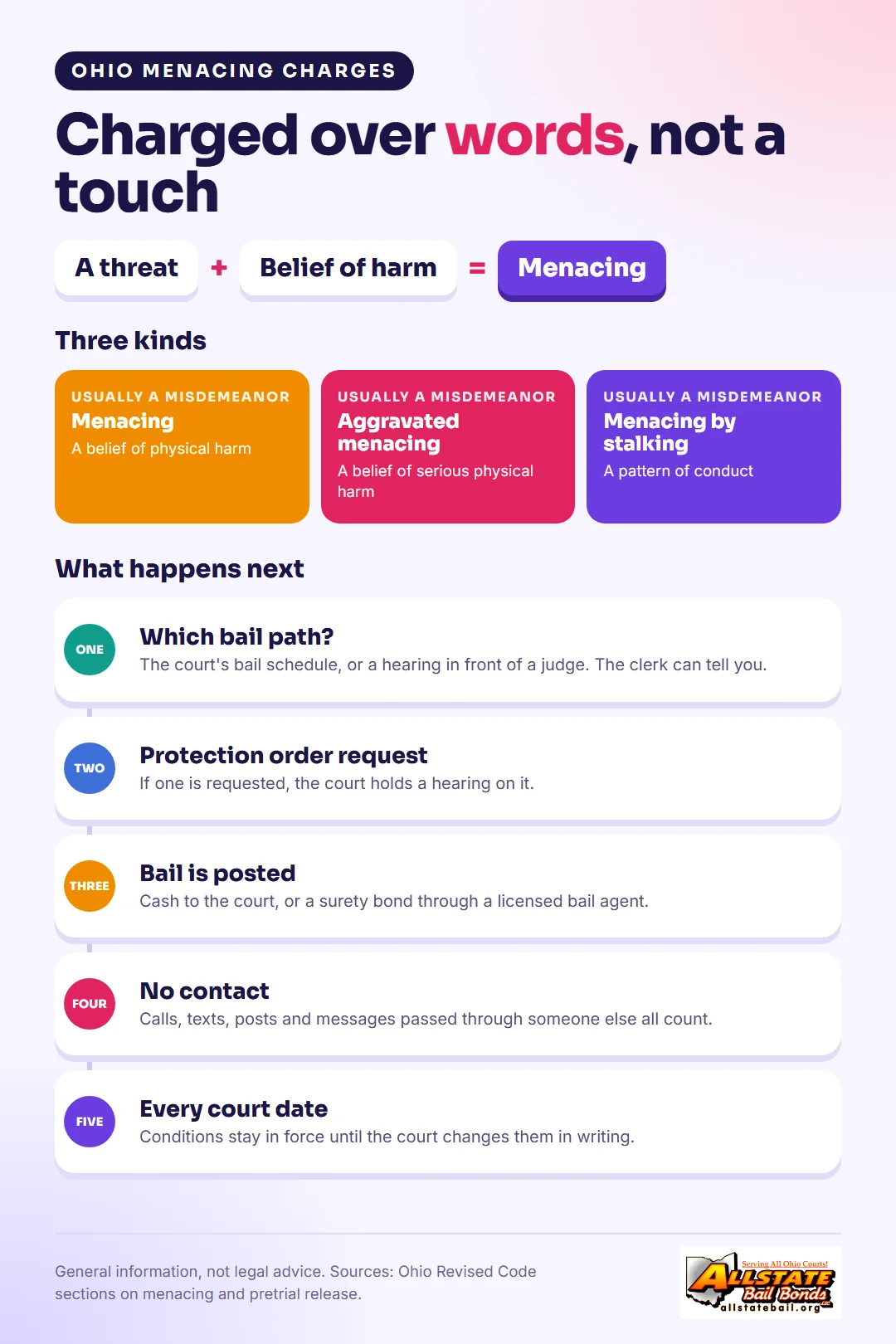
Quick answer: menacing is a charge about words or conduct that made another person believe they would be harmed. Nobody has to be touched. Ohio has three versions: menacing, aggravated menacing and menacing by stalking. Most are misdemeanors, so bail may be available from the court’s bail schedule, but when a protection order is requested the person may have to see a judge first. Once bail is set it can be paid in cash or posted through a licensed bail agent as a surety bond, and release almost always comes with a no-contact condition.
Families often hear about this charge with real confusion: there was an argument, a message or a voicemail, and no one was hurt. This guide explains what the law actually says, how bail usually works on these charges, and why the days after release matter so much.
In this guide
- What menacing means under Ohio law
- The three kinds of menacing charge
- How bail works on a menacing charge
- Protection orders and the hearing
- What “no contact” really covers
- How a bail bond helps, and what to have ready
- What to avoid while the case is open
- Frequently asked questions
What menacing means under Ohio law
Ohio’s menacing statute is Revised Code 2903.22. It makes it an offense to knowingly cause another person to believe that you will cause physical harm to them, to their property, to their unborn child or to a member of their immediate family.
Two things stand out. First, the charge is about what the other person was led to believe, not about an injury. Second, a threat aimed at property or at a family member counts as well as one aimed at the person. Whether a statement really was a threat, and whether it was made knowingly, are questions for the defense attorney and the court. For the family, the practical point is that the charge can be filed and the person can be held even though nobody was touched.
The three kinds of menacing charge
| Charge | In plain words | Usual level |
|---|---|---|
| Menacing (R.C. 2903.22) | Causing a belief of physical harm to a person, their property or their family | Fourth-degree misdemeanor |
| Aggravated menacing (R.C. 2903.21) | Causing a belief of serious physical harm | First-degree misdemeanor |
| Menacing by stalking (R.C. 2903.211) | A pattern of conduct that causes a belief of physical harm, or causes mental distress | First-degree misdemeanor |
Each statute also lists situations that raise the level, and some of them turn the charge into a felony. Ask for the exact charge, the code section and the level as written on the complaint. That one line tells you which bail path applies.
How bail works on a menacing charge
Ohio’s pretrial release law, R.C. 2937.011, has each court keep a bail schedule for misdemeanors. Where the schedule applies, bail can be available without waiting for a hearing. That is the short path.
The longer path is a hearing in front of a judge. The same law calls for an initial bail hearing no later than the second court day after the arrest for a person who has not been released. Expect the longer path when:
- the charge has been filed at a felony level;
- a protection order has been requested;
- the court’s own rules have people charged with these offenses appear before a judge;
- another court has a hold on the person.
You do not have to guess. The facility or the clerk of the court handling the case can tell you whether bail has been set and, if not, when the hearing is. Our list of questions to ask the jail covers exactly what to ask.
When bail is set, there are usually three ways forward: release on the person’s own recognizance, cash bail paid to the court, or a surety bond posted by a licensed bail agent so the family does not pay the full amount up front. Nobody outside the court can promise what a judge will decide.
Protection orders and the hearing
Menacing charges often come with a request for a protection order. Under R.C. 2903.213, the person who made the report, or others the statute names, can ask the court for a protection order as a condition of pretrial release, and the court holds a hearing on that request.
If the order is granted, it becomes part of the release conditions. It is a court order with its own terms, separate from the bond. Posting bail does not soften it, and only the court can change it.
What “no contact” really covers
The order’s own wording controls, so read it line by line. These conditions typically reach further than people expect:
- Calls and voicemail, including returning a missed call;
- Texts, e-mail and messaging apps;
- Social media, including comments, tags and reactions;
- Showing up at a home, workplace or school;
- Messages through someone else, such as a friend or relative passing along an apology.
If the two people share a home, children or a workplace, raise that with the defense attorney right away so the court can address it. Do not work out a private arrangement. A broken condition can put the person back in custody and lead to a new charge.
How a bail bond helps, and what to have ready
A bail bondsman cannot change the charge, speed up a hearing or influence the judge. What a good one does is carry the release work: verifying where the person is held and whether bail has been set, explaining the cash and surety options, and handling the paperwork and posting the bond once bail is set.
Have this ready when you call:
- the person’s full legal name and date of birth;
- the county and the facility, if you know it;
- the exact charge, code section and level;
- whether bail is already set, or the court and hearing time;
- whether a protection order has been requested;
- your own name and a number where you can be reached.
In Ohio, surety bail bond agents are licensed through the Ohio Department of Insurance. Ask for a name and a license, and ask what you are signing. If you will be the co-signer, read what a cosigner actually agrees to first.
What to avoid while the case is open
- Reaching out to apologize or explain. It is the most common way a condition gets broken.
- Answering if the other person contacts you. The order binds the person charged, whoever starts the conversation.
- Posting about the case online. Posts can be read as contact, and they can be used in court.
- Asking a friend to pass a message. Indirect contact is still contact.
- Talking through the case on facility phones. Those calls are usually recorded.
- Missing a court date. A missed appearance can lead to a warrant and the loss of the bond.
Related guides: bail bonds for robbery charges in Ohio and the first 24 hours after an Ohio arrest.
Frequently asked questions
What is menacing in Ohio?
Under R.C. 2903.22, menacing means knowingly causing another person to believe that you will cause physical harm to them, their property, their unborn child or a member of their immediate family. Nobody has to be touched or hurt for the charge to be filed.
Is menacing a felony or a misdemeanor in Ohio?
Usually a misdemeanor. Menacing is generally a fourth-degree misdemeanor, and aggravated menacing and menacing by stalking are generally first-degree misdemeanors. Each statute lists situations that raise the level, and some of them make the charge a felony, so check the exact charge on the paperwork.
What is the difference between menacing and aggravated menacing?
The seriousness of the harm the other person was made to fear. Menacing involves a belief of physical harm. Aggravated menacing, R.C. 2903.21, involves a belief of serious physical harm.
Can someone be released without seeing a judge on a menacing charge?
Sometimes. Ohio courts keep a bail schedule for misdemeanors under R.C. 2937.011, so bail on a misdemeanor can be available before a hearing. Courts can treat these charges differently, especially when a protection order is requested, so the person may have to appear before a judge first. The facility or the clerk can tell you which applies.
What does a no-contact condition cover?
Read the order itself, because its wording controls. These conditions typically cover every kind of contact: calls, texts, e-mail, social media, showing up in person, and messages passed through another person. Breaking the condition can put the person back in custody and lead to a new charge.
What if the other person wants to drop the charge?
The decision belongs to the prosecutor, not to the person who made the report. Until a court changes the order in writing, every condition stays in force, even if the other person reaches out first. Questions about this go to the defense attorney.
Call us about a menacing charge, at any hour
Allstate Bail Bonds serves all Ohio courts at any hour, 365 days a year, including all holidays. A licensed local bail bondsman can verify the detention location and whether bail has been set, explain your options, and handle the paperwork and bond posting once it is. Find your nearest office on our Ohio locations page, including Defiance, Marion, Lima and Findlay.
About the author: Allstate Bail Bonds has served Ohio courts since 2007. The company is owned by Drew Evans, a licensed Ohio bail agent (license #724711). This article is general information for defendants and families, not legal advice. Each statute has detailed definitions and every case turns on its own facts, so confirm dates and conditions with the court and consult a defense attorney about your specific case. Last reviewed November 2026.
Sources: Ohio Revised Code 2903.22 (menacing), 2903.21 (aggravated menacing), 2903.211 (menacing by stalking), 2903.213 (protection order as a pretrial condition), 2937.011 (pretrial release and bail); Ohio Department of Insurance.
