

Quick answer: Ohio does not have one offense simply called harassment. After an arrest, the paperwork usually names telecommunications harassment or menacing by stalking. Both are usually misdemeanors on a first offense, so bail may be available from the court’s bail schedule; if the charge is filed as a felony, a judge sets bail at a hearing held no later than the second court day. Once bail is set, it can be paid in cash or posted through a licensed bail agent as a surety bond. Release normally comes with conditions, and staying off the phone with the other person is the one that matters most.
These cases often begin with a phone: calls that kept coming, a string of texts, posts or messages after someone asked for them to stop. This guide walks through what the charge means and what happens in the hours and days after the arrest.
In this guide
- What “harassment” means on Ohio paperwork
- Telecommunications harassment
- Menacing by stalking
- What happens after the arrest, step by step
- Release conditions and your phone
- How a bail bond helps, and what to have ready
- What to avoid while the case is open
- Frequently asked questions
What “harassment” means on Ohio paperwork
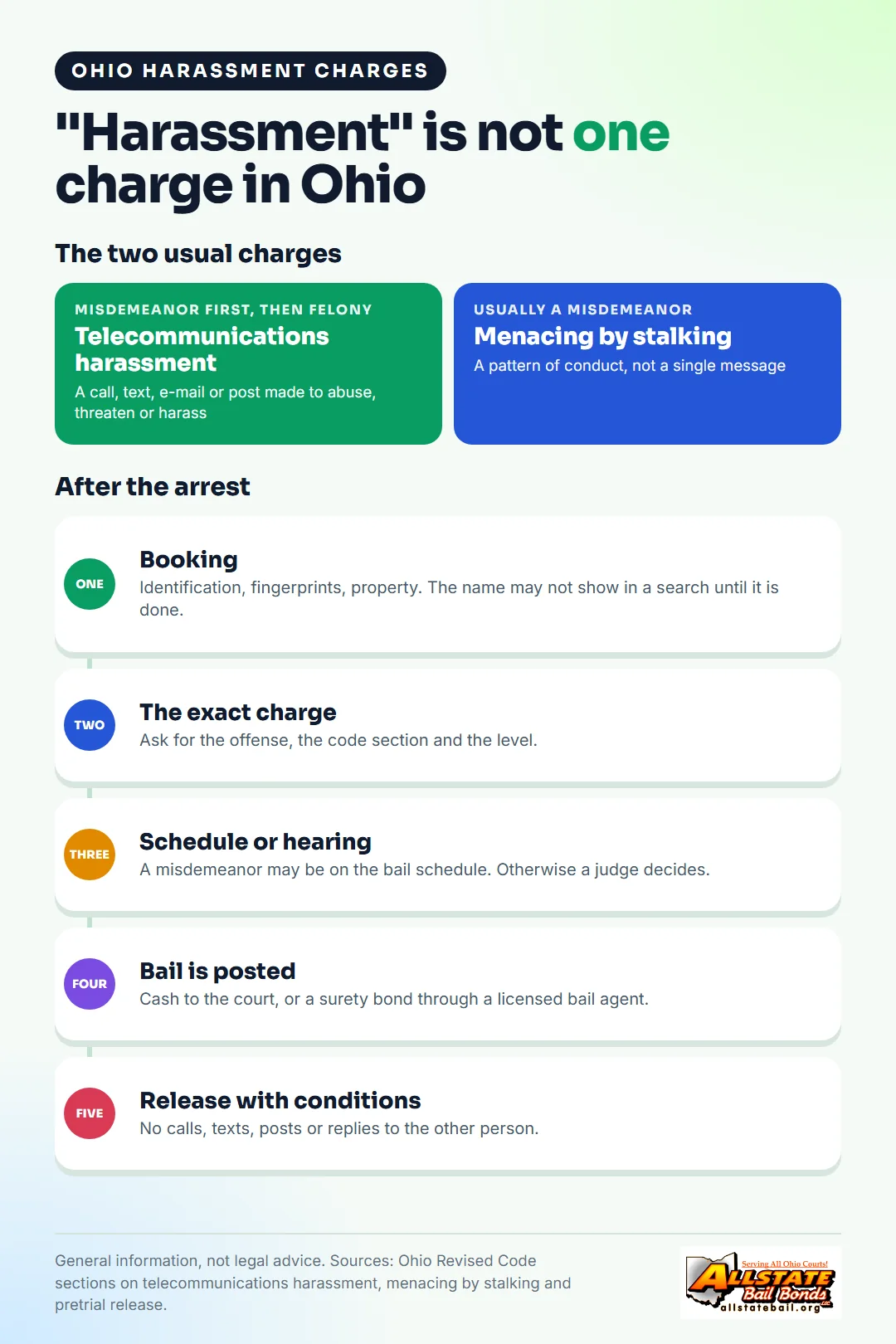
People say “he was arrested for harassment”, but the complaint will name a specific offense with a code section. The two that come up most are:
| Charge | In plain words | Usual level |
|---|---|---|
| Telecommunications harassment (R.C. 2917.21) | A call, text, e-mail or online message made with the purpose to abuse, threaten or harass | First-degree misdemeanor on a first offense; fifth-degree felony on each later offense |
| Menacing by stalking (R.C. 2903.211) | A pattern of conduct that makes another person believe they will be harmed, or causes them mental distress | First-degree misdemeanor, unless a situation the statute lists raises it to a felony |
The same events can lead to both charges at once. Ask the facility or the clerk for the exact charge, the code section and the level. Those three facts decide almost everything that follows.
Telecommunications harassment
R.C. 2917.21 began as a law about harassing phone calls. It was expanded in 2016 and now reaches modern electronic communication as well. At its core, it covers a telecommunication made with the purpose to abuse, threaten or harass another person, and it lists several more specific versions, such as continuing to contact someone who has said to stop.
Purpose is a central question in these cases, and it is one for the defense attorney and the court. For the family, the practical points are simpler: a single phone can produce several counts, and a prior conviction for the same offense changes the level from a misdemeanor to a felony.
Menacing by stalking
R.C. 2903.211 is about a pattern, not one message. It covers a pattern of conduct that knowingly causes another person to believe they will be physically harmed, or causes them mental distress. The pattern can include messages and posts as well as showing up in person. Our guide to menacing charges in Ohio covers this family of offenses in more detail.
What happens after the arrest, step by step
- Booking. Identification, fingerprints, photographs and property. A name may not show in an online search until booking is finished.
- The exact charge. The complaint names the offense, the code section and the level. Write all three down.
- Bail: schedule or hearing. Under R.C. 2937.011, each court keeps a bail schedule for misdemeanors, so bail may be available without waiting for a judge. A felony-level charge, a hold from another court or the court’s own rules can mean a hearing first. The same law calls for an initial bail hearing no later than the second court day after the arrest for a person who has not been released.
- Bail is posted. The family can pay cash bail to the court or work with a licensed bail agent on a surety bond.
- Release, with conditions. The facility completes its own release steps, and the person leaves with written conditions.
Each step waits on a different office. Our list of questions to ask the jail helps with the first three. Nobody outside the court can promise what a judge will decide or how long a facility will take.
Release conditions and your phone
A judge can attach conditions to release, and on these charges a no-contact condition is common. When the charge is menacing by stalking, the other person can also ask the court for a protection order as a pretrial condition under R.C. 2903.213.
Read the written conditions line by line, because their wording controls. In practice, no contact usually means:
- no calls, voicemail, texts or e-mail;
- no direct messages, comments, tags or reactions on social media;
- no messages passed through a friend or relative;
- no replies, even when the other person writes first.
Because the charge itself is about communication, a new message after release can break a condition and also become a new count. If the two people share children, a home or a workplace, tell the defense attorney at once so the court can address it.
How a bail bond helps, and what to have ready
A bail bondsman cannot change the charge, speed up a hearing or influence the judge. What a good one does is carry the release work: verifying where the person is held and whether bail has been set, explaining the cash and surety options, and handling the paperwork and posting the bond once bail is set.
Have this ready when you call:
- the person’s full legal name and date of birth;
- the county and the facility, if you know it;
- the exact charge, code section and level;
- whether bail is already set, or the court and hearing time;
- whether any other court has a hold;
- your own name and a number where you can be reached.
In Ohio, surety bail bond agents are licensed through the Ohio Department of Insurance. Ask for a name and a license, and ask what you are signing. If you will be the co-signer, read what a cosigner actually agrees to first.
What to avoid while the case is open
- Deleting messages or accounts. It can look like hiding evidence. Leave everything as it is and let the attorney decide.
- Sending “one last message”. An explanation or an apology is still contact.
- Posting about the case or the other person. Posts can be read as contact and used in court.
- Using a different number or account. The condition covers the person, not the device.
- Talking through the case on facility phones. Those calls are usually recorded.
- Missing a court date. A missed appearance can lead to a warrant and the loss of the bond.
Related guides: bail bonds for menacing charges in Ohio and the first 24 hours after an Ohio arrest.
Frequently asked questions
Is harassment a crime in Ohio?
The conduct can be, but Ohio’s criminal code does not use one offense simply named harassment. The charge on the paperwork is usually telecommunications harassment under R.C. 2917.21 or menacing by stalking under R.C. 2903.211. Ask for the exact charge and code section.
What is telecommunications harassment?
It is making a telecommunication, such as a call, a text, an e-mail or an online message, with the purpose to abuse, threaten or harass another person. The statute lists several specific versions of the offense, so the exact wording on the complaint matters.
Is telecommunications harassment a misdemeanor or a felony?
Under the statute’s main provisions, a first offense is a first-degree misdemeanor and each later offense is a fifth-degree felony. The complaint states the level being charged.
How soon is bail set after a harassment arrest in Ohio?
It depends on the level. Ohio courts keep a bail schedule for misdemeanors under R.C. 2937.011, so bail on a misdemeanor may be available without waiting. Otherwise a judge sets it at a hearing held no later than the second court day after the arrest for a person who has not been released.
Can the person text an apology after being released?
Not if a no-contact condition is in place, and one is common on these charges. An apology is still contact. Any message to the other person should go through the defense attorney.
What if the other person keeps messaging first?
The conditions bind the person who was charged, whoever starts the conversation. Do not answer. Save the messages and give them to the defense attorney.
Call us about a harassment charge, at any hour
Allstate Bail Bonds serves all Ohio courts at any hour, 365 days a year, including all holidays. A licensed local bail bondsman can verify the detention location and whether bail has been set, explain your options, and handle the paperwork and bond posting once it is. Find your nearest office on our Ohio locations page, including Celina, Defiance, Lima and Findlay.
About the author: Allstate Bail Bonds has served Ohio courts since 2007. The company is owned by Drew Evans, a licensed Ohio bail agent (license #724711). This article is general information for defendants and families, not legal advice. Each statute has detailed definitions and every case turns on its own facts, so confirm dates and conditions with the court and consult a defense attorney about your specific case. Last reviewed November 2026.
Sources: Ohio Revised Code 2917.21 (telecommunications harassment), 2903.211 (menacing by stalking), 2903.213 (protection order as a pretrial condition), 2937.011 (pretrial release and bail); Ohio Department of Insurance.
