

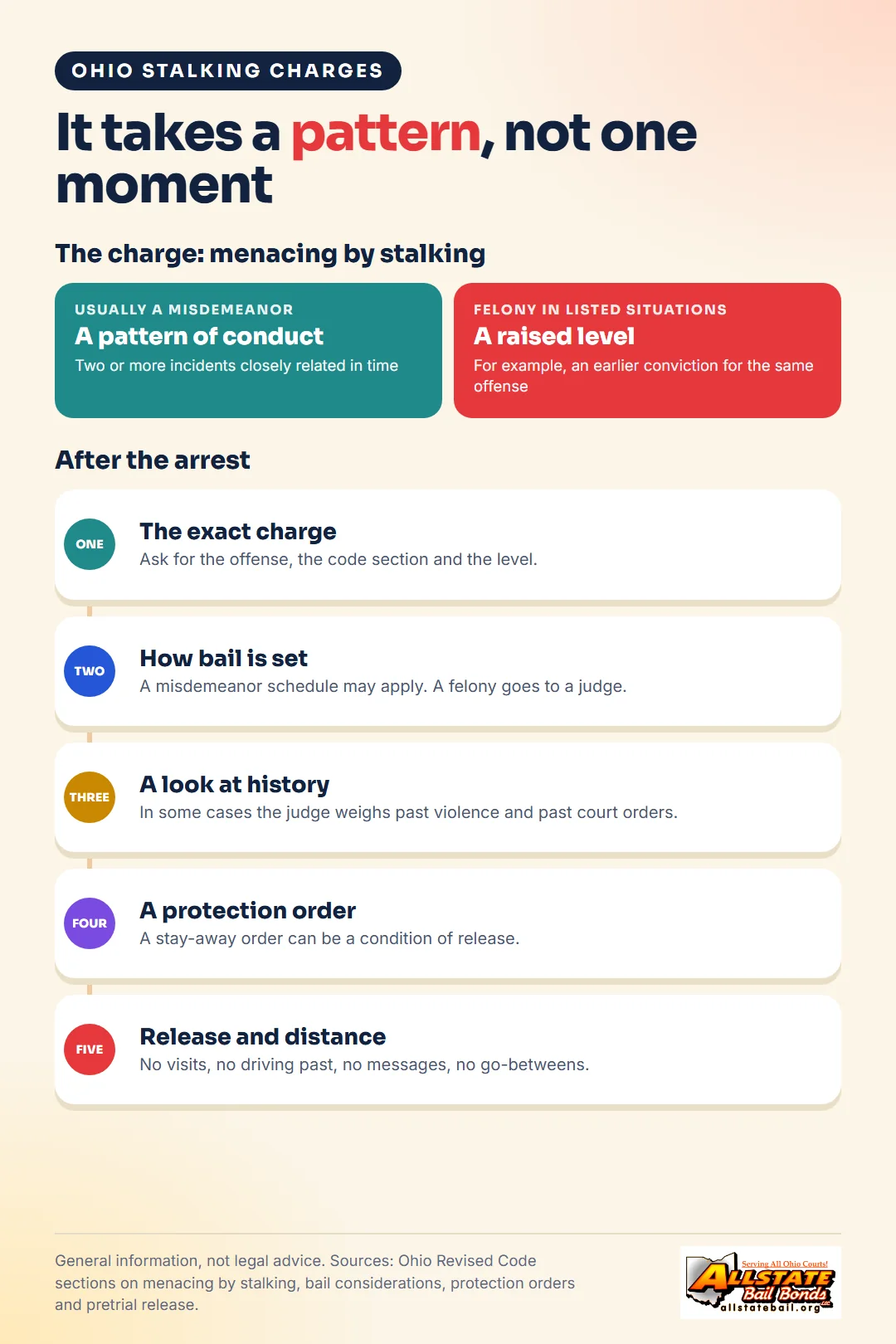
Quick answer: Ohio charges stalking as menacing by stalking. It is about a pattern of conduct, not a single moment, and two incidents close together in time can be enough. The charge is usually a first-degree misdemeanor, and a felony in situations the statute lists. Bail may come from the court’s schedule or from a judge at a hearing, and in some cases the judge must look at the person’s history first. Once bail is set, it can be paid in cash or posted through a licensed bail agent as a surety bond. Release almost always comes with an order to stay away from the other person.
Families are often surprised by this charge. They hear that nobody was hurt and nobody was threatened, and they cannot see where the crime is. This guide explains what the law looks at, how bail works, and what the person must do after release to avoid a second arrest.
In this guide
- What Ohio calls stalking
- What counts as a pattern
- Misdemeanor or felony
- How bail is set on a stalking charge
- Protection orders: two kinds
- After release: distance is the job
- What a bail bondsman does, and what to have ready
- Frequently asked questions
What Ohio calls stalking
The offense is menacing by stalking, R.C. 2903.211. A person commits it by engaging in a pattern of conduct that knowingly causes another person to believe they will be physically harmed, or that causes them mental distress. The conduct can happen in person, and it can also happen through messages, posts and other electronic means.
Two parts of that definition matter most to a family trying to understand the arrest: the word pattern, and the fact that the law looks at the effect on the other person.
What counts as a pattern
The statute defines a pattern of conduct as two or more actions or incidents closely related in time. It does not set a number of days, so a court looks at the facts of each case.
| What families often say | What the law looks at |
|---|---|
| “It only happened twice.” | Two incidents can be a pattern if they are closely related in time. |
| “He never threatened anyone.” | Ohio courts have said an explicit threat is not required. Repeated conduct can be enough. |
| “It was all online.” | Messages and posts can be part of the pattern. |
| “They used to be together.” | A past relationship does not cancel the charge, and it can bring other laws into the case. |
Whether the facts actually meet the definition is a question for the defense attorney and the court. For the family, the point is simpler: the charge does not depend on one dramatic event.
Misdemeanor or felony
Menacing by stalking is generally a first-degree misdemeanor. The statute lists situations that raise it to a fourth-degree felony. One example is an earlier conviction for the same offense. The complaint names the level being charged, so ask the facility or the clerk for three things: the exact charge, the code section and the level.
The level matters because it changes which court handles the case and how bail is set. If the paperwork says something different from stalking, our guides to menacing charges and harassment charges cover the related offenses.
How bail is set on a stalking charge
- Misdemeanor level. Under R.C. 2937.011, each court keeps a bail schedule for misdemeanors. On this charge, many courts still want the person to appear before a judge, especially when a protection order has been requested.
- Felony level. A judge sets bail at a hearing. The same law calls for that hearing no later than the second court day after the arrest for a person who has not been released.
- A closer look at history. R.C. 2903.212 applies to some stalking and menacing cases. Where it applies, the judge considers specific points before setting bail: any history of violence toward the other person, the accused person’s mental health, any history of violating court orders, whether the person is a potential threat to someone else, and whether a high bail would interfere with treatment or counseling.
The defense attorney can tell you whether that section applies to your case. Nobody outside the court can promise what a judge will decide, or how long any step will take.
Protection orders: two kinds
A stalking case can involve two different orders, and people often mix them up.
| Criminal protection order | Civil stalking protection order | |
|---|---|---|
| Law | R.C. 2903.213 | R.C. 2903.214 |
| Where it comes from | The criminal case, as a condition of pretrial release | A separate petition in the court of common pleas |
| How long it lasts | While the criminal case is open | Up to five years |
| Worth knowing | The court holds a prompt hearing after the request | It can include electronic monitoring |
Either order is a written document, and its wording controls. The person should keep a copy and read every line, including the addresses and the distance it names.
After release: distance is the job
On most charges, the main rule after release is to come back to court. On this one there is a second rule that matters just as much: stay away. In practice that usually means:
- no going to the other person’s home, workplace or school, and no driving past them;
- no calls, texts, e-mail, comments, tags or direct messages;
- no messages carried by friends or relatives;
- no “accidental” meetings at places the person is known to go;
- leaving at once if the two end up in the same place by chance.
The charge itself is about repeated conduct, so one more contact after release can break a condition and also be treated as another incident. If the two people share a home, children or a workplace, tell the defense attorney right away so the court can deal with it in writing.
What a bail bondsman does, and what to have ready
A bail agent does not argue the case and has no say over the judge or the conditions. The agent’s part is the release itself: confirming where the person is held and whether bail has been set, explaining the cash and surety options, and completing the paperwork and posting the bond once the amount is known.
Before you call, write down:
- the person’s full legal name and date of birth;
- the county, and the facility if you know it;
- the exact charge, code section and level;
- whether a hearing is scheduled, and in which court;
- whether a protection order has been requested or issued;
- a number where you can be reached at any hour.
Surety bail bond agents in Ohio are licensed through the Ohio Department of Insurance. If you are asked to sign for the bond, read what a cosigner actually agrees to before you do, and keep the list of questions to ask the jail next to the phone.
Frequently asked questions
What is the stalking law in Ohio?
Ohio’s criminal stalking offense is menacing by stalking, R.C. 2903.211. It covers a pattern of conduct that knowingly causes another person to believe they will be physically harmed, or that causes them mental distress.
How many incidents make a pattern of conduct?
The statute defines a pattern of conduct as two or more actions or incidents closely related in time. There is no fixed number of days. Whether the incidents are close enough in time is decided on the facts of each case.
Does there have to be a threat for a stalking charge?
No. Ohio courts have said that an explicit threat is not required. Repeated conduct, such as following someone or showing up again and again, can be enough when it causes a belief of harm or mental distress.
Is menacing by stalking a felony in Ohio?
It is generally a first-degree misdemeanor. The statute lists situations that make it a fourth-degree felony, for example an earlier conviction for the same offense. The complaint states which level is charged.
How is bail set on a stalking charge in Ohio?
On a misdemeanor, the court’s bail schedule under R.C. 2937.011 may apply, although many courts want the person to see a judge on this charge. On a felony, a judge sets bail at a hearing held no later than the second court day after the arrest for a person who has not been released.
Can the person go home after posting bail?
That depends on the written conditions. If the home is shared with, or close to, the protected person, a stay-away condition can make it off limits. Read the order first and ask the defense attorney before going anywhere near an address it names.
Talk to a licensed bail bondsman, day or night
Allstate Bail Bonds serves all Ohio courts around the clock, every day of the year, holidays included. A licensed local bondsman can find out where your family member is held and whether bail has been set, walk you through the options, and take care of the paperwork and the bond posting. See our Ohio locations page for the nearest office, including Ottawa, Marion, Fremont and Findlay.
About the author: Allstate Bail Bonds has served Ohio courts since 2007. The company is owned by Drew Evans, a licensed Ohio bail agent (license #724711). This article is general information for defendants and families, not legal advice. The statutes have detailed definitions and conditions, and every case turns on its own facts, so confirm dates and orders with the court and speak with a defense attorney about your case. Last reviewed November 2026.
Sources: Ohio Revised Code 2903.211 (menacing by stalking), 2903.212 (bail considerations), 2903.213 (protection order as a pretrial condition), 2903.214 (civil stalking protection order), 2937.011 (pretrial release and bail); Ohio Department of Insurance.
