

Quick answer: criminal trespass in Ohio does not require a break-in. It means entering or staying on someone else’s property without the right to be there. It is usually a fourth-degree misdemeanor, so a person who is booked may be able to post bail from the court’s bail schedule without waiting for a judge. Some people receive a summons with a court date instead. If bail is set, it can be paid in cash or posted through a licensed bail agent as a surety bond. After release, the most important rule is simple: do not go back to the property.
Families are often puzzled by this charge because nothing was taken and nothing was damaged. Someone cut across a fenced lot, stayed in a store after an argument, or went back to a former home. This guide explains what the law covers and what to expect next.
In this guide
- What counts as criminal trespass
- Charged for staying, not for entering
- How serious is it?
- Summons or arrest: what happens next
- How bail works on a trespass charge
- After release: do not go back
- When a bail bondsman is needed
- Frequently asked questions
What counts as criminal trespass
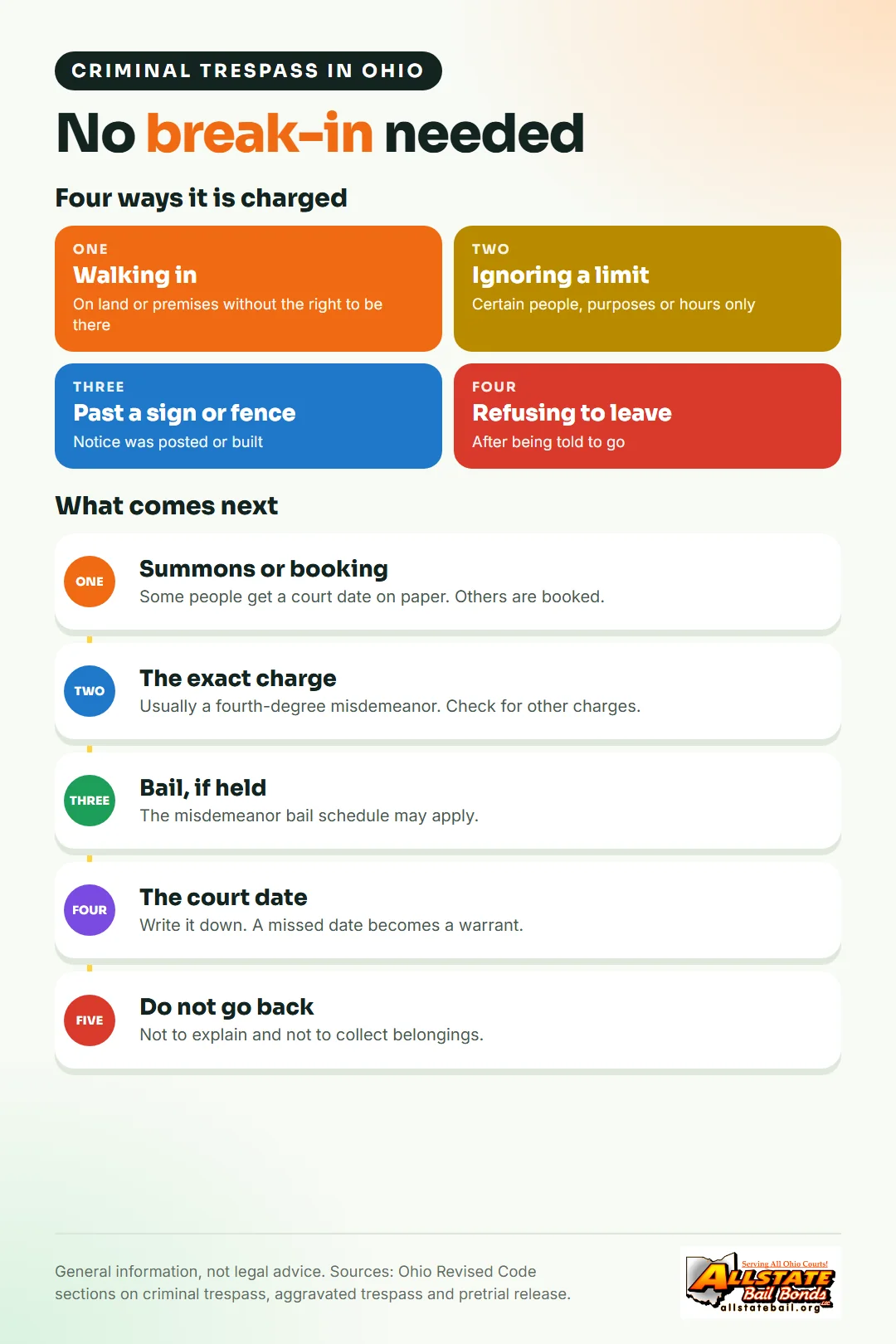
R.C. 2911.21 applies to a person who acts “without privilege to do so”. Privilege means a right or permission to be there, such as an invitation, a lease or a business being open to the public. The statute then lists the ways the offense is committed. In plain words:
| The situation | Example |
|---|---|
| Entering or remaining on another person’s land or premises | Walking through a private yard or lot |
| Entering or remaining where use is limited to certain people, purposes or hours | A park after closing time, or an area marked for staff only |
| Entering or remaining where notice against access was given | Going past a “No Trespassing” sign or a fence |
| Failing or refusing to leave after being told to | Staying after the owner or an employee says to go |
Notice does not have to be a conversation. A sign or a fence designed to keep people out can be enough. The same statute also covers certain protected facilities at a higher level.
Charged for staying, not for entering
The last row surprises people most. A person can walk into a store, a bar or a relative’s house with every right to be there and still be charged, because the right ended when they were told to leave. The same is true for someone who was barred from a property earlier and comes back. For the family, the useful question is: who told the person to leave, when, and was it in writing?
How serious is it?
- Criminal trespass is generally a fourth-degree misdemeanor, one of the lower levels in Ohio’s criminal code.
- Aggravated trespass, R.C. 2911.211, is a separate offense. It applies when a person enters or remains on a property with the purpose of committing a misdemeanor that involves hurting someone or making someone believe they will be hurt. It is a first-degree misdemeanor.
- More serious charges. If the facts involve getting into a building by force, stealth or deception to commit a crime, the charge may be burglary, which is a felony.
A low level does not mean it can be ignored. A conviction is still a criminal record, and a missed court date turns a small case into a warrant.
Summons or arrest: what happens next
- Summons or booking. Some people are given a paper with a court date and sent home. Others are taken in and booked, especially if they would not leave, have other charges or have an open warrant.
- The exact charge. The complaint names the offense, the code section and the level. Trespass is often filed together with other charges, so read all of them.
- Bail, if the person is held. See the next section.
- The first court date. The person enters a plea, and the court can add conditions such as staying away from the property.
How bail works on a trespass charge
Under R.C. 2937.011, each court keeps a bail schedule for misdemeanors. On a trespass charge alone, bail may therefore be available from the schedule without waiting for a judge. A hearing can still be needed when there are other charges, a hold from another court or a warrant. For a person who has not been released, the same law calls for an initial bail hearing no later than the second court day after the arrest.
Ask the facility three things: the exact charges, whether bail is already set on each one, and whether any other court has a hold. No one outside the court can promise what a judge will decide or how long a facility will take to finish its own release steps.
After release: do not go back
Most second arrests on this charge happen the same way: the person returns to the property. The reasons sound sensible at the time, and each of them can lead to a new charge.
| The reason to go back | What to do instead |
|---|---|
| To explain or apologize | Let the defense attorney handle any contact |
| To pick up belongings, a car or a paycheck | Ask the attorney or the court how property can be collected, or send someone who is welcome there |
| “It is a public place” | If the owner barred the person, the bar still applies until it is lifted |
| “I live there” or “I used to live there” | Housing questions are for the attorney and, if needed, the court; do not test them at the door |
Keep the summons or bond paperwork, write down the court date, and keep any written notice that barred the person from the property.
When a bail bondsman is needed
If the person received a summons, there is no bail to post. A bail bondsman comes in when the person is being held and bail has been set, often because trespass is one of several charges. The agent verifies where the person is and the bail on each charge, explains the cash and surety options, and handles the paperwork and the posting of the bond.
Have this ready when you call: the person’s full legal name and date of birth, the county, the charges, whether bail is set, and your own phone number. Ohio surety bail bond agents are licensed through the Ohio Department of Insurance. Our list of questions to ask the jail covers the rest.
Frequently asked questions
What is criminal trespass in Ohio?
Under R.C. 2911.21, it is entering or remaining on another person’s land or premises without privilege to be there. The statute lists several ways it can happen, including ignoring a posted sign or fence and refusing to leave after being told to.
Is criminal trespass a felony in Ohio?
Generally no. Criminal trespass is usually a fourth-degree misdemeanor. Aggravated trespass, a separate offense under R.C. 2911.211, is a first-degree misdemeanor. The complaint states the exact charge and level.
Can I be charged if the door or gate was open?
Yes. The question is whether the person had privilege to be there, not whether anything was locked or broken. An open gate is not permission.
Can I be charged with trespassing in a store or other public place?
Yes. A person who entered lawfully can be charged for staying after being told to leave by the owner, the occupant or someone acting for them, or for returning after being barred from the property.
Will someone be arrested or just given a summons for criminal trespass?
Either can happen. Some people are handed a summons with a court date, and others are taken into custody and booked. If the person is booked, the court’s misdemeanor bail schedule under R.C. 2937.011 may apply.
What is the difference between criminal trespass and burglary?
Trespass is about being on the property without privilege. Burglary adds more, such as using force, stealth or deception to get into a structure with a purpose to commit a crime inside, and it is a felony. The same event can be charged as either, depending on the facts.
Reach a licensed bail bondsman any time
Allstate Bail Bonds serves all Ohio courts day and night, all year, including holidays. A licensed local bondsman can verify where your family member is held and whether bail has been set, explain your options and handle the paperwork and bond posting. Find your nearest office on our Ohio locations page, including Perrysburg, Findlay and Marion.
About the author: Allstate Bail Bonds has served Ohio courts since 2007. The company is owned by Drew Evans, a licensed Ohio bail agent (license #724711). This article is general information for defendants and families, not legal advice. The statutes have detailed definitions and every case turns on its own facts, so confirm the charge and dates with the court and speak with a defense attorney about your case. Last reviewed November 2026.
Sources: Ohio Revised Code 2911.21 (criminal trespass), 2911.211 (aggravated trespass), 2937.011 (pretrial release and bail); Ohio Department of Insurance.
