

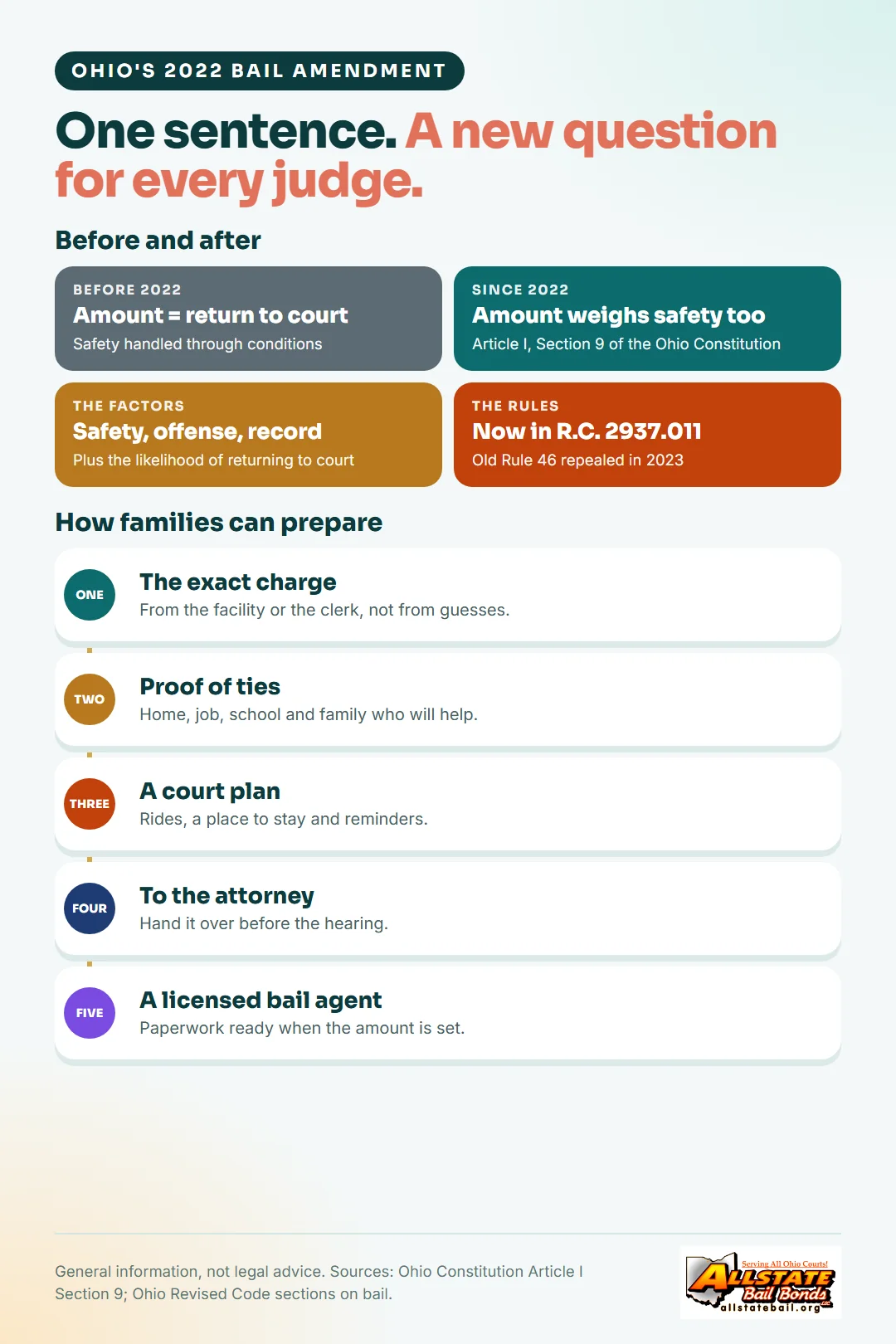
Quick answer: since Ohio voters approved Issue 1 on November 8, 2022, the Ohio Constitution requires a court to consider public safety when it decides the amount of bail. That includes the seriousness of the offense, the person’s criminal record, how likely the person is to come back to court, and any other factor the General Assembly sets. Before the amendment, the Ohio Supreme Court had treated the amount as a tool for getting a person back to court and left safety to the conditions of release. For families, it means a judge can look at more than the person’s finances, so it pays to arrive at the bail hearing ready to show ties to the community and a reliable plan for court.
Bail law can feel like it changes every year, and in Ohio it really did change between 2022 and 2023. This guide explains the one sentence that was added to the state constitution, why it was added, and what it means when someone you love is waiting for a bail decision.
In this guide
- What Ohio bail looked like before 2022
- The sentence the voters added
- The factors, in plain words
- What the amendment did not change
- Why the bail rules moved into the Revised Code
- What this means at a bail hearing
- How families can prepare
- Frequently asked questions
What Ohio bail looked like before 2022
In January 2022 the Ohio Supreme Court decided DuBose v. McGuffey. A divided court held that the bail set in that murder case was excessive and explained its view of bail: the amount is meant to make sure the person returns to court, while concerns about public safety are handled through the conditions a judge attaches to release, such as no contact or monitoring. Many prosecutors and lawmakers disagreed, and the General Assembly put a constitutional amendment on the November 2022 ballot. Voters approved it.
The sentence the voters added
The amendment added this to Article I, Section 9 of the Ohio Constitution:
“When determining the amount of bail, the court shall consider public safety, including the seriousness of the offense, and a person’s criminal record, the likelihood a person will return to court, and any other factor the general assembly may prescribe.”
It also removed the language that had tied bail procedures to the Ohio Supreme Court’s rule-making power. The text and the background of the measure are summarized on Ballotpedia’s page on Ohio Issue 1 (2022).
The factors, in plain words
| Factor | What a judge may look at | What the family can bring |
|---|---|---|
| Public safety | Whether release would put a person or the community at risk | A safe place to live, people who will help, willingness to follow conditions |
| Seriousness of the offense | The charge and its level, as filed | The exact charge from the paperwork, so nobody is guessing |
| Criminal record | Prior convictions and how earlier cases went | Proof of completed sentences or programs, if any |
| Likelihood of returning to court | History of showing up, ties to the area | Job, home, family, school, a written plan for rides to court |
| Other factors set by law | Anything the General Assembly adds by statute | Questions for the defense attorney about what applies |
None of these factors decides a case alone. The amendment tells judges what they must weigh; the outcome still depends on the facts of each case. Our guide on how Ohio judges decide whether to set bail walks through the hearing itself.
What the amendment did not change
- Bail is still a right in most cases. The constitution still says all persons shall be bailable, with the narrow exceptions it already listed.
- Holding someone without bail still needs a hearing. For certain serious charges, R.C. 2937.222 lets the prosecutor or the judge ask for a hearing on denying bail. That is a separate process; our article on whether bail can be denied in Ohio explains it.
- Conditions still matter. Judges still set conditions such as no contact, travel limits or reporting, alongside the amount. See how Ohio courts set pretrial release conditions.
- Bail still cannot be excessive. The ban on excessive bail in the Ohio and U.S. constitutions still applies.
Why the bail rules moved into the Revised Code
Before the amendment, the details of bail procedure lived in the Ohio Rules of Criminal Procedure, Rule 46, which the Supreme Court controls. Once the amendment removed that link, the General Assembly wrote the procedures into statute. The result is R.C. 2937.011, which took effect in 2023, and the old Rule 46 was repealed. Among other things, the statute:
- requires an initial bail hearing no later than the second court day after the arrest for a person who has not been released;
- requires a second bail hearing when the person had no lawyer at the first one and is still held;
- keeps misdemeanor bail schedules, which allow release before the first court appearance, and requires each court to review its schedule so it does not cause unnecessary detention because a person cannot pay.
Our guide to Ohio bail schedules covers the misdemeanor side in more detail.
What this means at a bail hearing
On a misdemeanor covered by the schedule, the change often makes little difference on the first night: the scheduled bail is posted and the person goes home with a court date. On a felony, the hearing is where the amendment shows up. The prosecutor may argue public safety and the seriousness of the charge; the defense answers with the person’s ties, record and plan. The judge then sets an amount and conditions together. If the amount seems out of reach, the defense can later ask for a review, which our article on requesting a bail reduction hearing explains.
How families can prepare
- Get the exact charge and the hearing time from the facility or the clerk.
- Collect proof of ties: a lease or utility bill, a pay stub or a letter from an employer, school records, names of family who will help.
- Write a court plan: who drives, where the person will stay, how reminders will work.
- Give it to the defense attorney before the hearing, not after.
- Call a licensed bail agent early so the paperwork is ready the moment an amount is set.
When a bail bondsman is needed
Once a judge sets the amount, the family can pay it in cash to the court or work with a licensed bail agent on a surety bond. The agent verifies where the person is held and the bail on each charge, explains the cash and surety options, and handles the paperwork and the posting of the bond. Ohio surety bail bond agents are licensed through the Ohio Department of Insurance.
Frequently asked questions
What did Ohio’s 2022 bail amendment change?
Ohio voters approved Issue 1 on November 8, 2022. It added to Article I, Section 9 of the Ohio Constitution that when a court decides the amount of bail, it must consider public safety, including the seriousness of the offense, the person’s criminal record, the likelihood the person will return to court, and any other factor the General Assembly sets.
Why was the bail amendment proposed?
It followed the Ohio Supreme Court’s January 2022 decision in DuBose v. McGuffey, which treated the amount of bail as a tool for making sure a person comes back to court and left public safety to the conditions of release. The amendment made public safety a factor in the amount itself.
Does the amendment mean bail is higher for everyone?
No. It changes what a judge must weigh, not the result in any one case. Each bail decision still depends on the charge, the person’s record and history of coming to court, and the other factors the law lists.
Can a judge still deny bail in Ohio?
Only in limited cases. Ohio’s constitution and R.C. 2937.222 allow a judge to deny bail for certain serious charges after a hearing, when the judge finds a substantial risk of serious physical harm to a person or the community. The 2022 amendment is about the amount of bail, not about who can be held without bail.
Where are Ohio’s bail rules now?
After the amendment took bail procedures out of the Ohio Supreme Court’s rule-making, the General Assembly put the rules into the Revised Code. R.C. 2937.011 now covers pretrial release, bail schedules for misdemeanors and the initial bail hearing, which must be held no later than the second court day after an arrest for a person who is still held.
Does the amendment change misdemeanor bail schedules?
Courts still keep bail schedules for misdemeanors under R.C. 2937.011, and that law requires each court to review its schedule so it does not cause unnecessary detention because a person cannot pay. A schedule allows release before the first court appearance; a judge can still review bail at that appearance.
Reach a licensed bail bondsman any time
Allstate Bail Bonds serves all Ohio courts day and night, all year, including holidays. A licensed local bondsman can verify where your family member is held and whether bail has been set, explain your options and handle the paperwork and bond posting. Find your nearest office on our Ohio locations page, including Tiffin, Findlay and Fremont.
About the author: Allstate Bail Bonds has served Ohio courts since 2007. The company is owned by Drew Evans, a licensed Ohio bail agent (license #724711). This article is general information for defendants and families, not legal advice. Every bail decision turns on its own facts, so speak with a defense attorney about your case. Last reviewed November 2026.
Sources: Ohio Constitution, Article I, Section 9; Ballotpedia, Ohio Issue 1 (2022); Ohio Revised Code 2937.011 (pretrial release and bail) and 2937.222 (hearing on denying bail); Ohio Department of Insurance.
