

Quick answer: before you contact a bail bondsman, it helps to ask the jail eight things: is the person in custody, has booking finished, what are the charges, which court has the case, has bail been set and for how much, are there any holds, how and when is bail accepted, and when is the first court date. You will not always get every answer, and that is fine. Write down what you do get, with the name of the person you spoke to, and bring it to the bondsman.
Calling a jail for the first time can be intimidating. You may be upset, the person answering may be busy, and you may not know the right words. A short list changes that call. It keeps you focused, gets you real information in a few minutes, and means the next person you talk to can help you faster.
In this guide
- Before you dial
- The eight questions, and why each one matters
- A simple script you can read from
- What the jail probably will not tell you
- If you cannot get through
- What to tell the bail bondsman next
- Frequently asked questions
Before you dial
Have the person’s full legal name, spelled the way it appears on their ID, and their date of birth. A common name without a birth date can send you in circles.
Next, make sure you are calling the right place. The county where the arrest happened is the usual starting point, but not always the place the person is held. Some Ohio counties share a regional jail: the Corrections Center of Northwest Ohio in Stryker, for instance, serves Defiance, Fulton, Henry, Lucas and Williams counties. If you are unsure, start with our guide on not knowing which jail someone is in.
Many facilities also have an online inmate search. It is worth a look first, but remember that a very recent arrest may not be listed yet.
The eight questions, and why each one matters
1. “Is this person in your custody?”
Everything else depends on this. If the answer is no, ask whether they might have been taken somewhere else, and try a neighboring county.
2. “Has booking finished?”
If booking is still underway, details such as the charges or bail may not be available yet. That is a good reason to ask when it makes sense to call back, instead of calling every ten minutes. Our guide to how jail intake affects release timing explains what happens in those hours.
3. “What are the charges?”
You do not need to understand the legal details. Just write down what you are told, word for word. A bondsman and an attorney can both use that information, and it often tells you which court is involved.
4. “Which court has the case?”
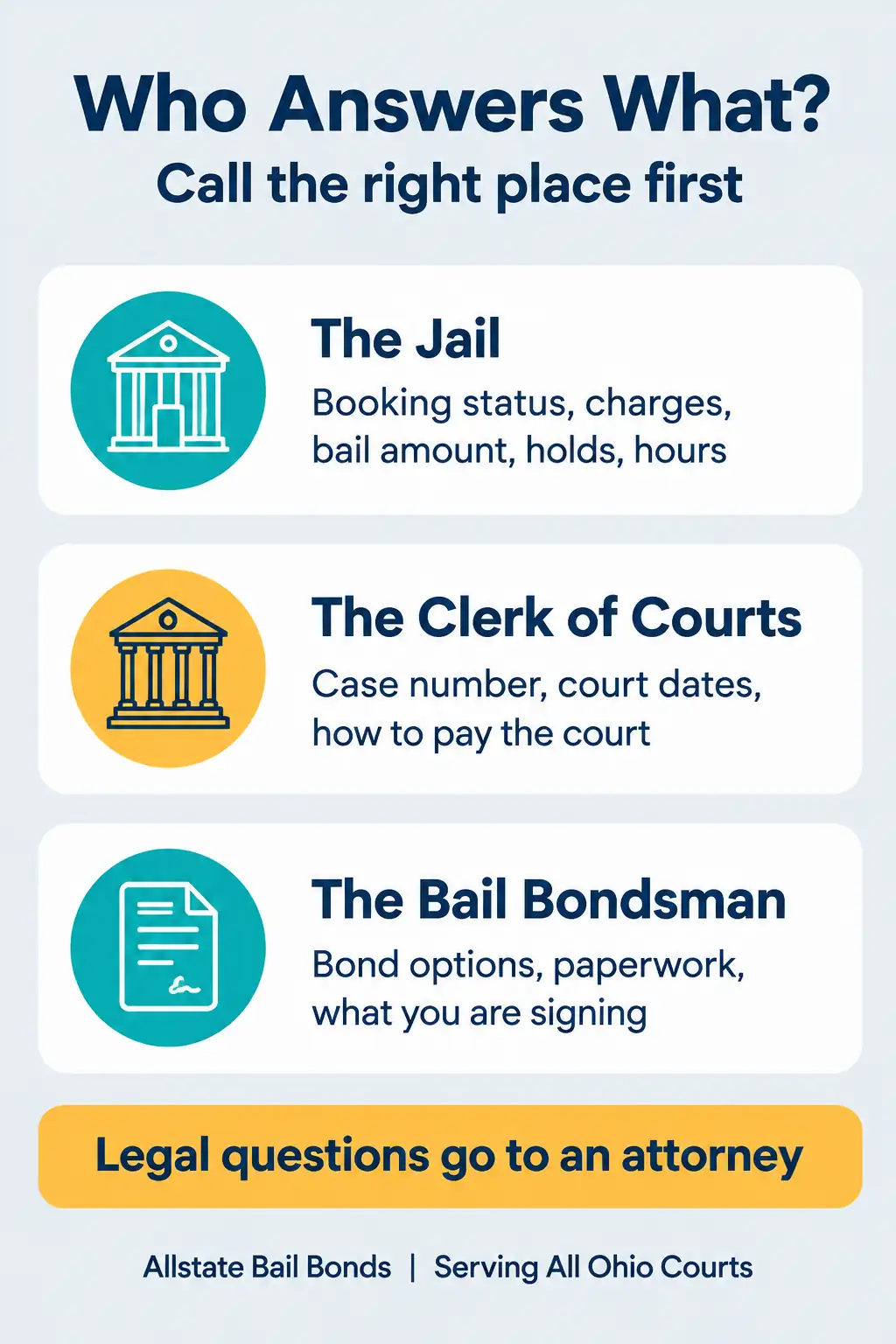
Ohio counties can have more than one municipal court as well as a Court of Common Pleas, and each one has its own clerk. Knowing the court tells you who to call about dates, case numbers and paperwork. Ask for a case number if there is one.
5. “Has bail been set, and for how much?”
Ask for the exact amount and whether it applies to one charge or several. If bail has not been set, ask when the person is expected to see a judge. Under Ohio Revised Code 2937.011, someone arrested and not released must have an initial bail hearing no later than the second court day after the arrest. Some facilities describe a faster routine: the Corrections Center of Northwest Ohio says new arrivals appear for arraignment on the next regular court day.
6. “Are there any holds from another court or county?”
This may be the most valuable question on the list. A hold is a separate reason to keep someone in custody, and a bond on one case will not clear it. If there is one, write down which court or agency placed it.
7. “How is bail accepted, and during what hours?”
Rules differ. Ask where a bond or payment is received, what forms of payment are taken if you plan to pay the court directly, and whether anything changes at night or on weekends.
8. “When is the first court date?”
It may not be set yet. If it is, write it down immediately and put it on your calendar. Missing a date after release can have serious consequences; see what happens if a court date is missed.
A simple script you can read from
“Hello, my name is ____. I’m trying to find out about ____, date of birth ____. Is that person in your custody? … Has booking been finished? … Can you tell me the charges and which court has the case? … Has bail been set, and how much is it? … Are there any holds? … How and when do you accept bail? … Is there a first court date yet? … May I have your name, please? Thank you.”
Be polite and brief. The person answering may be handling many calls at once, and a calm, organized caller usually gets further. Before you hang up, note the time and the name of the person you spoke to. If you get two different answers later, that note is how you sort them out.
What the jail probably will not tell you
- Legal advice. Staff cannot tell you whether the charges are strong or what the person should do. Ask a defense attorney.
- An exact release time. Processing depends on the facility and the day, so treat any time as an estimate.
- A way to talk to the person right now. Calls usually cannot be transferred in. The Corrections Center of Northwest Ohio says its receptionist cannot pass along messages, and that people can make at least two collect calls during booking, though those may be delayed in some cases.
- Everything over the phone. Some information may be limited, or available only on a website or in person. Rules vary by county, so ask what the facility can share.
Practical rules vary too. The Stark County Sheriff’s Office, for example, no longer accepts money for inmates by mail. Asking your facility saves a wasted trip or a lost envelope.
If you cannot get through
Jail phone lines get busy, especially at night and after a weekend. If you keep hitting a wall:
- check the facility’s or sheriff’s website for an inmate search or a booking list;
- call the clerk of courts in the county once offices open, and ask about the case;
- try again at a different hour, because shift changes can be busy;
- call a licensed bail bondsman, who can help verify the location and bail amount.
You also do not have to finish the list before you ask for help. If all you have is a name, that is still enough to start. For more on what you can look up yourself, read how to find Ohio jail booking and release information.
What to tell the bail bondsman next
Once you have your notes, the next call should be quick. Share:
- the person’s full name and date of birth;
- the facility, the charges and the court;
- the bail amount, and whether it is cash or another form;
- any holds you were told about;
- any court date you know;
- your own name and a good number to reach you.
Then it is your turn to ask. In Ohio, surety bail bond agents are licensed through the Ohio Department of Insurance, so ask for a name and license. Ask what you are signing and what you would be responsible for, and read what a cosigner actually agrees to if you will be co-signing. If it is still early in the day, our guide to the first 24 hours after an arrest covers what else to take care of.
Frequently asked questions
Will the jail tell me the bail amount over the phone?
Many Ohio facilities will, but not all of them, and what staff can share varies by county. If you cannot get the amount, ask which court has the case and call that clerk. A bail bondsman can also help verify it.
Do I have to call the jail before calling a bail bondsman?
No. You can call a bondsman first, and verifying the location and bail amount is part of what a good one does. Calling the jail first simply means you start the conversation with better information, and you may learn about a hold that changes your plan.
What if the jail says the person is not there?
Check the spelling and date of birth, then ask whether booking could still be underway. Also consider a neighboring county or a regional facility, because some Ohio counties house people in a shared jail outside the county.
Can jail staff pass a message to someone in custody?
Often not. The Corrections Center of Northwest Ohio, for example, says its receptionist cannot give messages to an inmate and that calls cannot be transferred, though a real family emergency goes to the shift commander. Ask your facility how it handles emergencies.
Can the jail tell me whether my family member should plead or what will happen in court?
No. Jail staff run the facility and generally cannot give legal advice. Questions about the charges, a plea or what to say belong with a defense attorney.
What should I bring or have ready before I call?
The person’s full legal name and date of birth, a pen and paper, and if possible where and when the arrest happened. Keep your phone charged, since a return call or a collect call from the facility may come from a number you do not recognize.
Call us with whatever you have
A full list of answers is helpful, but it is never required. Allstate Bail Bonds serves all Ohio courts at any hour, 365 days a year, including all holidays. A licensed local bail bondsman can verify the detention location and bail amount, explain cash and surety bond options, and handle the paperwork and bond posting once bail is set. Find your office on our Ohio locations page, including Napoleon, Canton and Findlay.
About the author: Allstate Bail Bonds has served Ohio courts since 2007. The company is owned by Drew Evans, a licensed Ohio bail agent (license #724711). This article is general information for families, not legal advice. Facility rules vary by county and change over time, so confirm details with the facility or the court, and consult an attorney about your specific case. Last reviewed November 2026.
Sources: Ohio Revised Code 2937.011 (pretrial release); Corrections Center of Northwest Ohio, First 48 Hours in Jail; CCNO, How to Contact an Inmate; Stark County Sheriff’s Office, Inmate Services; Ohio Department of Insurance.
