

Quick answer: intake is the set of steps a person goes through when they arrive at an Ohio jail: booking, a health screen, classification and property inventory. Release usually cannot happen until the facility can identify the person, match the paperwork and confirm there are no holds. So intake can add hours, and a late-night or weekend arrest can add more, because bail may need a judge and Ohio’s deadline for that hearing is counted in court days.
Families often assume that once bail is paid, the door opens. In practice two clocks are running: the facility’s clock and the court’s clock. Knowing which one you are waiting on tells you who to call, what to ask, and whether anything can be done right now.
In this guide
- What happens during intake, stage by stage
- The court’s clock: when bail gets set
- Why nights, weekends and holidays feel longer
- Holds: the delay families do not see coming
- What happens after bail is posted
- Questions to ask the facility
- What actually helps, and what does not
- Frequently asked questions
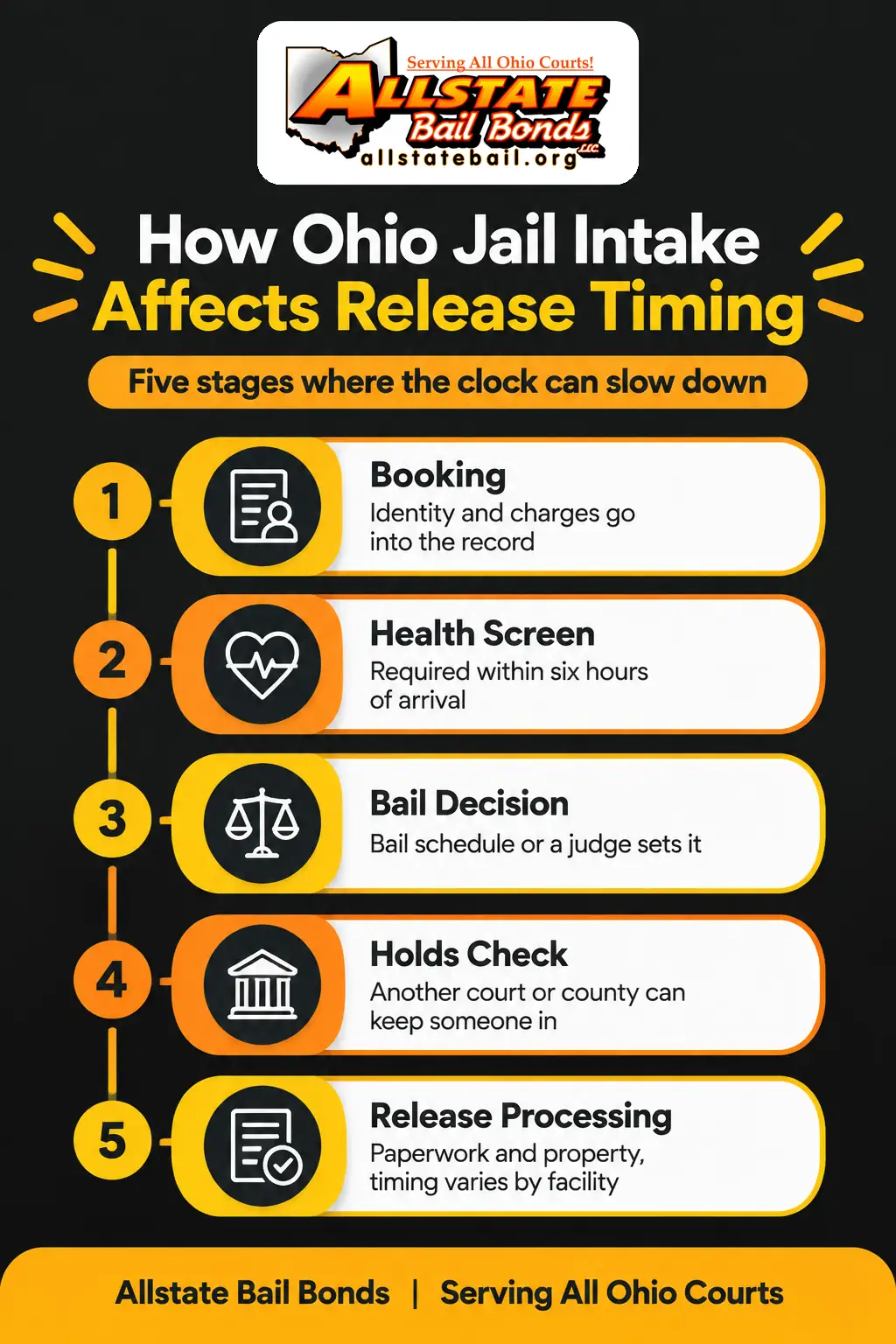
What happens during intake, stage by stage
The order and names vary by county, but Ohio’s minimum standards for full-service jails require facilities to have written procedures for receiving and releasing people. Here is how each stage can touch the timing of a release.
| Stage | What happens | How it can affect timing |
|---|---|---|
| Booking | Name, charges and the time of commitment go into the booking record. Photos and fingerprints are taken where required. | Until the record exists, a bond has nothing to attach to. A wrong name or an ID question can slow this down. |
| Health screen | Trained staff complete a written medical, dental and mental health screening. | The rule allows up to six hours from arrival. A serious condition may mean treatment before the person is accepted into the facility. |
| Property inventory | Personal items are listed and stored, and the person signs for them or a witness notes that they did not. | Usually short, but it has to be reversed at release, when items are returned against a receipt. |
| Classification | Staff decide where in the facility the person will be housed. | Mostly matters if the person stays. It can affect how quickly staff can bring them to the release area. |
| Records and holds check | Staff look for warrants, detainers or other cases. | A hold from another court can keep someone in custody even after bail is posted on this case. |
The six-hour figure comes from Ohio Administrative Code 5120:1-8-09, which calls for a receiving screen within six hours of arrival and before placement in general population. It is a health safeguard, not a release deadline, but it explains why a person may be unreachable for a while after arriving. If you are not yet sure which facility is involved, start with our guide on what to do when you don’t know which jail someone is in.
The court’s clock: when bail gets set
Intake is the facility’s job. Bail belongs to the courts, and there are two main routes in Ohio.
- A bail schedule. Under Ohio Revised Code 2937.011, courts keep a bail schedule for misdemeanors. The statute says its purpose is to allow release to be considered before the person’s first court appearance. When a schedule applies, bail may be known during or soon after booking.
- A judge. When no schedule amount applies, such as in many felony cases, the person generally waits for a judicial officer to decide. R.C. 2937.011(J)(1) says a person who was arrested and not released must have an initial bail hearing no later than the second court day following the arrest. That hearing can be combined with the first court appearance.
That deadline is an outer limit, so a hearing may come earlier. If the person has no lawyer at the first hearing and stays in custody, the same statute calls for a second bail hearing on the second court day after the first.
Separately, the U.S. Supreme Court held in County of Riverside v. McLaughlin (1991) that after a warrantless arrest, a judge’s probable-cause decision within 48 hours is presumed reasonable, and that a longer delay puts the burden on the government to justify it. That is a question about the arrest itself, not a release deadline, and an attorney is the right person to raise it.
Older articles often cite Ohio Criminal Rule 46 for bail. That rule was repealed in 2023, and its procedures now sit in R.C. 2937.011.
Why nights, weekends and holidays feel longer
Because the statute counts court days, the calendar matters. An arrest late on a Friday could mean an initial bail hearing as late as Tuesday, and later still if Monday is a court holiday. Facilities also run on shifts, so a busy night or a shift change can move a person’s paperwork back in line.
Timing is one of the most common reasons families feel stuck, and it is often nobody’s mistake. Our guide to how holidays affect bail bond processing in Ohio goes deeper on the calendar side.
Holds: the delay families do not see coming
A hold is a separate reason to keep someone in custody. It might be a warrant from another county, a probation matter, or a second case with its own bail. Posting a bond on one case does nothing to the others.
This is why it pays to ask about holds before you pay anything. If there are two cases, you may need two bonds, or the second matter may need to go before a judge first. Ask the facility, and ask your bondsman to check. If a warrant is involved, speak with an attorney about how to resolve it.
What happens after bail is posted
Posting bail starts the release process; it does not finish it. Typically the facility has to:
- receive the bond or payment and confirm it matches the case and the amount;
- check again for holds and any conditions the court attached;
- complete release paperwork, including the next court date;
- return property and collect a signed receipt;
- bring the person to the release area when staff are available.
How long that takes varies from county to county and from shift to shift, so be wary of anyone who promises an exact release time. Waiting where the person can reach you is the most useful thing to do: they may have no phone and no ride. Our guide on what happens to a phone and belongings after an arrest explains why they may not be able to call right away.
Questions to ask the facility
A short, specific call gets better answers than “when will they be out?”. Have the person’s full legal name and date of birth ready, then ask:
- Has booking been completed?
- What are the charges, and which court has the case?
- Has bail been set? Is it from a schedule, or is a judge deciding?
- When is the first court appearance?
- Are there any holds or other cases?
- How do you accept bail, and during which hours?
Many counties publish booking information online; see how to find Ohio jail booking and release information.
What actually helps, and what does not
What helps:
- Correct spelling of the legal name and an accurate date of birth, which avoids mix-ups.
- Telling staff about a serious medical need or required medication as early as possible.
- Keeping your phone on and answering unknown numbers. Our guide on calling someone in an Ohio jail explains why calls can come from unfamiliar lines.
- Having your ID and bond information ready, so paperwork can move as soon as bail is set.
- Getting legal advice from an attorney on anything about the case itself.
What does not help:
- Calling the facility over and over; one call per shift is usually enough.
- Paying before you know the bail amount and whether any holds exist.
- Asking the person to talk about the case on a recorded line.
Ohio law also protects contact after an arrest: R.C. 2935.20 says a person in custody must be permitted to communicate with an attorney, and R.C. 2935.14 addresses contacting an attorney or a relative or other person. Exactly how and when that happens depends on the facility.
Frequently asked questions
How long does jail intake take in Ohio?
There is no single statewide time. It depends on the facility, how many people are being processed and whether medical or identification issues come up. Ohio jail standards do set one clock: a receiving health screen within six hours of arrival. Call the facility for current status, because no one can honestly promise an exact time.
Can bail be posted before booking is finished?
Usually the facility needs to know who the person is and what the charges are before a bond can be matched to the case, so booking generally comes first. Bail paperwork can often be started while you wait. A bail bondsman can confirm whether the person is in the system and whether bail has been set.
How soon must a judge set bail in Ohio?
Under Ohio Revised Code 2937.011, a person who was arrested and has not been released must be brought before a judicial officer for an initial bail hearing no later than the second court day after the arrest. Weekends and court holidays are not court days, so they can stretch the wait.
Why is someone still in custody after bail was posted?
Common reasons are that the facility is still processing the release, the person has a hold from another court or county, or there is a separate case with its own bail. Ask the facility directly whether any holds exist and whether the bond has been received and accepted.
Does a hold from another county stop release?
It can. Posting bond on one case does not clear a warrant or hold from another court. Each hold needs its own answer, so ask about all of them before money changes hands. An attorney can advise on how to resolve a warrant.
Can a person in custody call family during intake?
Ohio law gives a person in custody the right to contact an attorney, and in many situations a relative or other person, but the exact timing and method of calls depends on the facility. If you have not heard anything yet, it may simply mean intake is still underway.
Need help while the clock is running?
Allstate Bail Bonds serves all Ohio courts, 24 hours a day, 7 days a week, 365 days a year, including all holidays. A licensed local bail bondsman confirms the detention location and bail amount, explains cash and surety bond options in plain words, and handles the paperwork and bond posting as soon as bail is set. We cannot control a facility’s processing time, but we can keep our part moving. Find your nearest office on our Ohio locations page, for example Findlay bail bonds or Lima bail bonds, or read what to do right after a family member is arrested.
About the author: Allstate Bail Bonds has served Ohio courts since 2007. The company is owned by Drew Evans, a licensed Ohio bail agent (license #724711). This article is general information about the intake and bail process, not legal advice. Procedures vary by county and facility, and laws change, so confirm details with the facility or the court and consult an attorney about your specific case. Last reviewed November 2026.
Sources: Ohio Revised Code 2937.011 (pretrial release); Ohio Adm.Code 5120:1-8-01 (reception and release); Ohio Adm.Code 5120:1-8-09 (medical screening); R.C. 2935.20; R.C. 2935.14; County of Riverside v. McLaughlin, 500 U.S. 44 (1991).
