

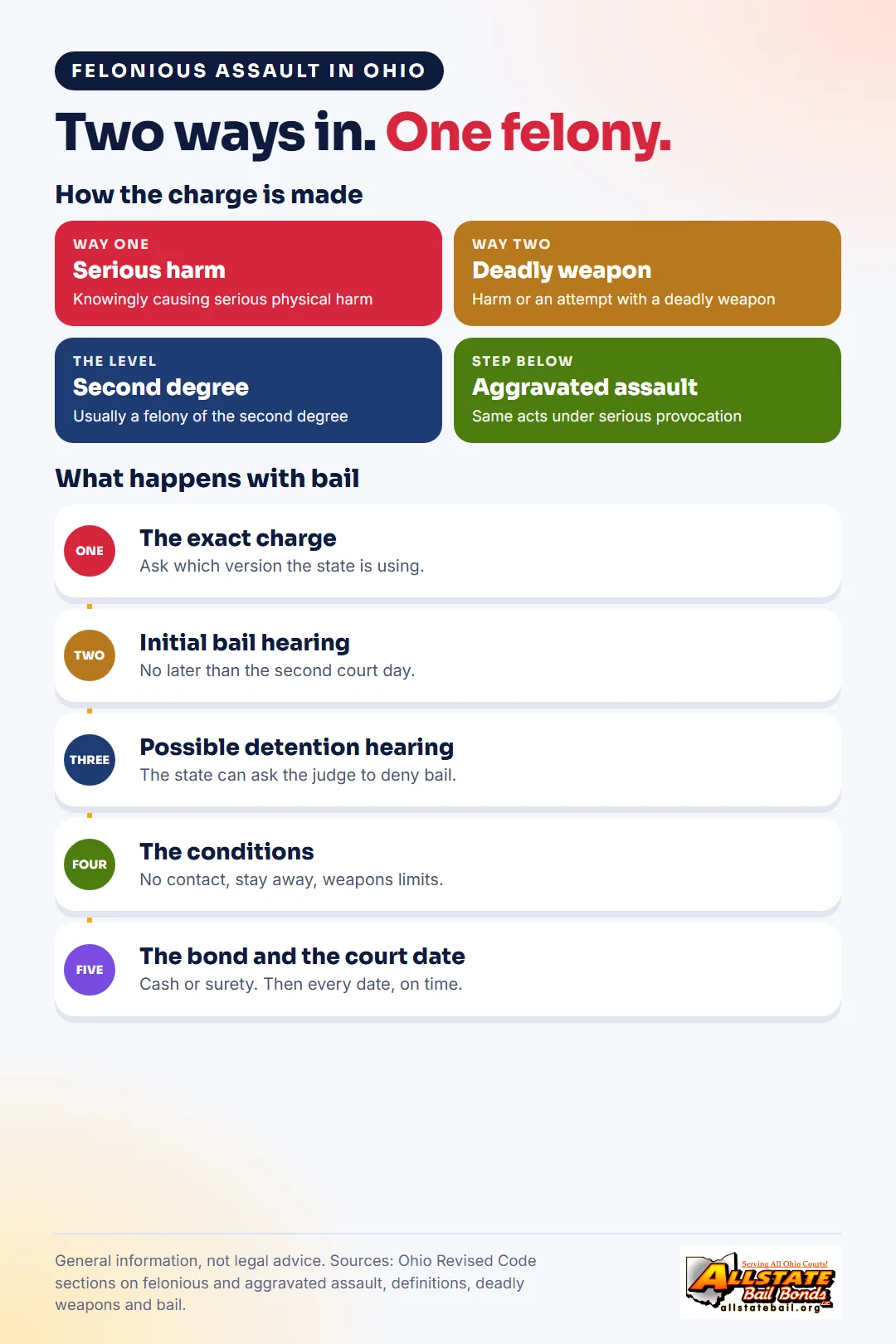
Quick answer: felonious assault in Ohio is usually a second-degree felony, and there are two separate ways to be charged with it: causing serious physical harm, or causing or even trying to cause harm with a deadly weapon. Because it is a felony, a judge sets bail, normally at a hearing held no later than the second court day after the arrest. On a second-degree felony the prosecutor can also ask the judge to hold a hearing on denying bail. When bail is set, it can be paid in cash or posted through a licensed bail agent as a surety bond, and the conditions that come with it, such as no contact, matter as much as the amount.
Families often hear “felonious assault” and assume someone was badly hurt. Sometimes that is true, but the charge can also rest on what was in a person’s hand. This guide explains both versions, how the charge compares with aggravated assault, and what to expect at each bail step.
In this guide
- The two ways to be charged
- What “serious physical harm” means
- What counts as a deadly weapon
- Felonious assault vs. aggravated assault vs. assault
- How bail works on this charge
- When the state asks to deny bail
- Conditions that usually come with release
- What the family can do now
- Frequently asked questions
The two ways to be charged
R.C. 2903.11 says no person shall knowingly do either of two things. Each one is a complete charge on its own:
| Version | What the state has to show | Is a serious injury needed? |
|---|---|---|
| Division (A)(1): serious harm | The person knowingly caused serious physical harm to another | Yes, that is the core of this version |
| Division (A)(2): deadly weapon | The person knowingly caused or attempted to cause physical harm with a deadly weapon or dangerous ordnance | No, even an attempt can be enough |
The word “knowingly” matters in both versions. Whether the facts show it is a question for the defense attorney and the court, not for the family on the first night.
What “serious physical harm” means
Ohio defines the phrase in R.C. 2901.01. In plain words, it covers harm that carries a substantial risk of death, causes permanent or substantial temporary incapacity, causes permanent or serious temporary disfigurement, or involves acute or prolonged pain. Certain serious mental conditions are included too. A medical record often becomes central to this version of the case.
What counts as a deadly weapon
Under R.C. 2923.11, a deadly weapon is anything capable of causing death that is designed or specially adapted as a weapon, or that is possessed, carried or used as one. That is why an ordinary object can be at the center of a felonious assault charge: what matters is how it was used. Our guide to bail for weapons charges covers the separate gun and weapon offenses that are sometimes filed alongside it.
Felonious assault vs. aggravated assault vs. assault
| Charge | The difference | Usual level |
|---|---|---|
| Felonious assault, R.C. 2903.11 | Serious harm, or harm or an attempt with a deadly weapon | Felony of the second degree |
| Aggravated assault, R.C. 2903.12 | The same acts, done under sudden passion or a sudden fit of rage brought on by serious provocation from the victim | Felony of the fourth degree |
| Assault, R.C. 2903.13 | Causing or trying to cause physical harm without the factors above | Usually a misdemeanor |
The levels rise in certain situations, for example when the person hurt is a peace officer. The charge on the first paperwork can also change later, so read every page of the complaint and ask the defense attorney which version the state is using.
How bail works on this charge
Misdemeanor bail can come from a court’s schedule, but felonious assault is a felony, so a judge sets the bail. Under R.C. 2937.011, a person who has not been released must have an initial bail hearing no later than the second court day after the arrest. Weekends and holidays do not count as court days. The judge looks at the factors the law lists, which our guide on how Ohio judges decide on bail explains, and sets the amount and the conditions together.
No one outside the court can tell a family what the bail will be. Be careful with anyone who promises an amount or a release time.
When the state asks to deny bail
R.C. 2937.222 lists the charges for which the prosecutor, or the judge on the court’s own motion, can call for a hearing on whether bail should be denied. A felony of the first or second degree is on that list, so a felonious assault charge can lead to that hearing. The person stays held until the hearing ends, and the law limits continuances: usually no more than three court days when the state asks, and five when the defense asks. At the hearing the accused has the right to a lawyer, and to an appointed one if they cannot afford it. Our article on whether bail can be denied in Ohio covers the standard the judge applies.
Conditions that usually come with release
- No contact with the person who was hurt, often including messages through friends or social media. See our guide to no-contact orders and bail conditions.
- Staying away from a home, a workplace or a place named in the order.
- Weapons restrictions while the case is open.
- Reporting or monitoring, when the judge orders it.
Breaking a condition can lead to a new charge and to losing the bond. If a condition conflicts with where the person lives or works, the defense attorney can ask the court to change it. The person should not decide alone.
What the family can do now
- Confirm the facility and the exact charge. Ask whether it is listed as felonious assault, and which division if they will say.
- Ask when the bail hearing is, and whether the state has asked for a detention hearing.
- Find a defense attorney or ask about the public defender before the hearing if you can.
- Do not contact the other person for the defendant, and do not pass messages.
- Call a licensed bail agent so the paperwork is ready the moment bail is set.
Our checklist for the first court appearance helps with the rest.
When a bail bondsman is needed
Once a judge sets bail, the family can pay the full amount in cash to the court or work with a licensed bail agent on a surety bond. The agent verifies where the person is held and the bail on each charge, explains the cash and surety options, and handles the paperwork and the posting of the bond. Ohio surety bail bond agents are licensed through the Ohio Department of Insurance.
Frequently asked questions
What is felonious assault in Ohio?
Under R.C. 2903.11, felonious assault is knowingly causing serious physical harm to another person, or causing or attempting to cause physical harm with a deadly weapon or dangerous ordnance. Either one is enough on its own.
Is felonious assault a felony?
Yes. In most cases it is a felony of the second degree. The level can be higher when the person hurt is a peace officer or a state criminal investigator, among other situations the statute lists.
Can someone be charged with felonious assault if nobody was badly hurt?
Yes. The weapon version covers causing or even attempting to cause physical harm with a deadly weapon. Serious injury is not required for that version.
What is the difference between felonious assault and aggravated assault in Ohio?
They describe the same kinds of acts. Aggravated assault applies when the person acted under sudden passion or a sudden fit of rage brought on by serious provocation from the victim. It is usually a felony of the fourth degree, while felonious assault is usually a felony of the second degree.
Can bail be denied on a felonious assault charge?
It can be considered. Because felonious assault is usually a felony of the second degree, R.C. 2937.222 allows the prosecutor or the judge to ask for a hearing on whether bail should be denied. The person is held until that hearing ends, and the law limits how long it can be delayed.
How fast does a judge set bail after a felonious assault arrest?
Under R.C. 2937.011, a person who has not been released must have an initial bail hearing no later than the second court day after the arrest. Weekends and holidays are not court days.
Reach a licensed bail bondsman any time
Allstate Bail Bonds serves all Ohio courts day and night, all year, including holidays. A licensed local bondsman can verify where your family member is held and whether bail has been set, explain your options and handle the paperwork and bond posting. Find your nearest office on our Ohio locations page, including Massillon, Canton and Mansfield.
About the author: Allstate Bail Bonds has served Ohio courts since 2007. The company is owned by Drew Evans, a licensed Ohio bail agent (license #724711). This article is general information for defendants and families, not legal advice. The statutes have detailed definitions and every case turns on its own facts, so confirm the charge and dates with the court and speak with a defense attorney about your case. Last reviewed November 2026.
Sources: Ohio Revised Code 2903.11 (felonious assault), 2903.12 (aggravated assault), 2901.01 (definitions, serious physical harm), 2923.11 (deadly weapon), 2937.222 (hearing on denying bail), 2937.011 (pretrial release and bail); Ohio Department of Insurance.
