

Quick answer: in Ohio, aggravated assault is a fourth-degree felony. Despite the name, it is a less serious charge than felonious assault, because it applies when a person acted in sudden passion or a sudden fit of rage after serious provocation. It is still a felony, so bail is normally set by a judge at a hearing instead of being read off a bail schedule. Ohio law puts that hearing no later than the second court day after the arrest. Once bail is set, a bail bond is one way to post it.
The call usually comes late, and the word that sticks is “aggravated”. It sounds like the worst version of an assault charge. In Ohio it is not, and knowing that helps you ask better questions in the first hours. This guide explains what the charge means, where it ranks, how bail is decided, which release conditions to expect, and what a family can do tonight.
In this guide
- What “aggravated assault” means in Ohio
- Assault, aggravated assault, felonious assault: how they rank
- How bail is set on an aggravated assault charge
- Release conditions: no contact and protection orders
- What to find out in the first hours
- How a bail bond helps, and what to have ready
- Mistakes that make the case harder
- Frequently asked questions
What “aggravated assault” means in Ohio
The offense is defined in Ohio Revised Code 2903.12. It covers a person who knowingly causes serious physical harm to someone else, or who causes or tries to cause physical harm with a deadly weapon, while under the influence of sudden passion or in a sudden fit of rage. That passion or rage has to be brought on by serious provocation from the other person, serious enough that it could reasonably push someone into using deadly force.
So the word “aggravated” does not mean “extra violent” here. The provocation is what sets this charge apart, and the law treats it as a reason to lower the degree of the offense. Ohio courts set the bar for provocation high. The Ohio Supreme Court has said it must be reasonably sufficient to bring on extreme stress, and appeals courts have found that an ordinary push or punch was not enough.
Assault, aggravated assault, felonious assault: how they rank
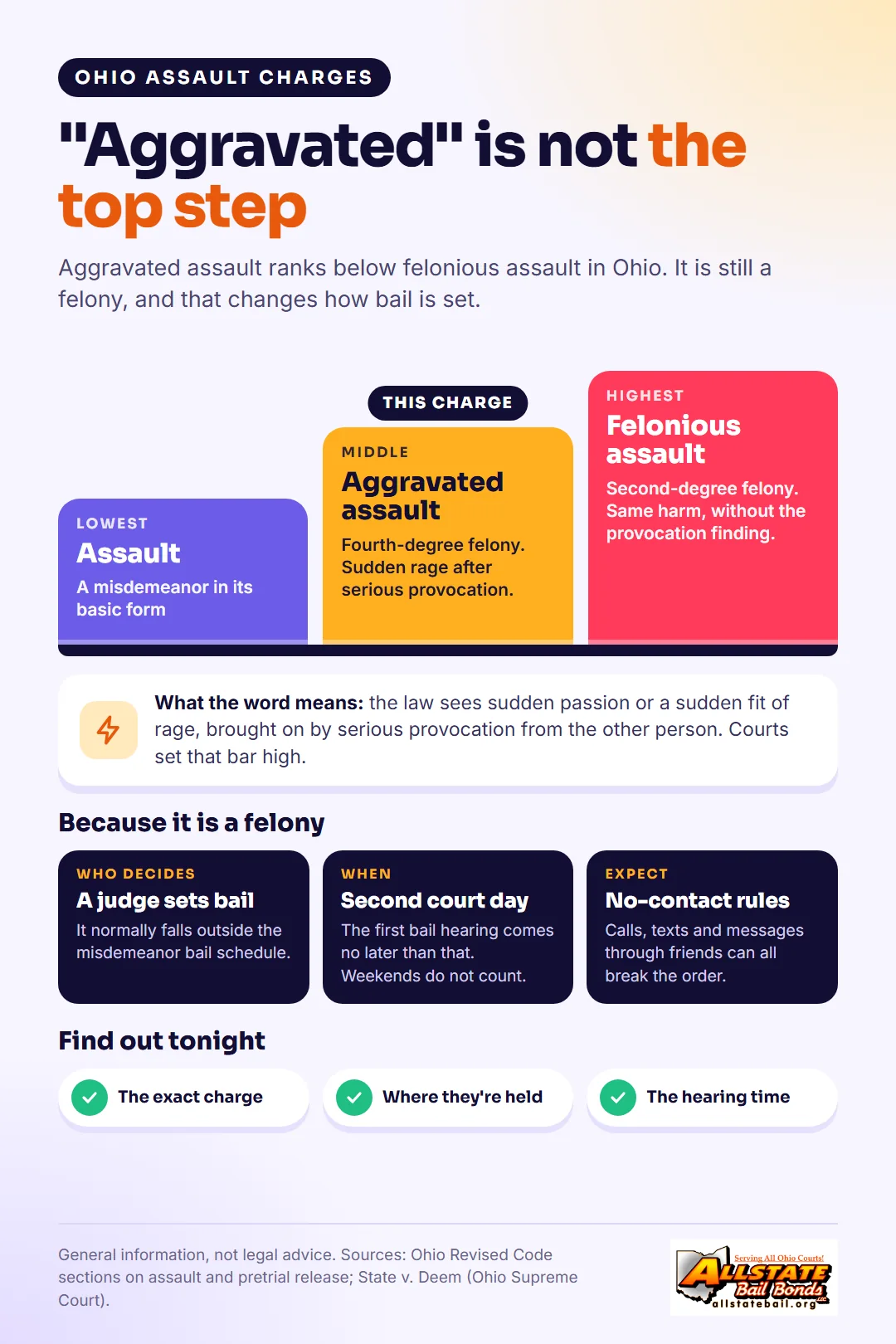
Three charges with similar names sit on three different levels:
- Assault (R.C. 2903.13): in its basic form, a misdemeanor.
- Aggravated assault (R.C. 2903.12): a fourth-degree felony. It is a third-degree felony when the alleged victim is a peace officer or a state BCI investigator.
- Felonious assault (R.C. 2903.11): a second-degree felony, the most serious of the three.
In State v. Deem, the Ohio Supreme Court described aggravated assault as an inferior degree of felonious assault: the same elements, plus the mitigating element of serious provocation. In practice a person is often charged with felonious assault at first, and whether the facts support aggravated assault is argued later by the defense. That is why the exact wording on the paperwork matters. Ask for it, and write it down as it is written.
How bail is set on an aggravated assault charge
Ohio’s pretrial release law, R.C. 2937.011, has every court keep a bail schedule that covers misdemeanors. A felony such as aggravated assault normally falls outside that schedule, so the person waits to see a judge. The same law says the initial bail hearing must be held no later than the second court day after the arrest. Weekends and court holidays are not court days.
At the hearing the judge decides the type of bail, the amount and the conditions. Judges typically weigh the seriousness of the charge along with the person’s record, ties to the community and history of coming to court. If the person had no lawyer at that first hearing and is still held, the law provides for a second bail hearing.
When bail is set, there are usually three ways forward:
- Own recognizance or an unsecured bond: release on a promise to appear, with conditions, and no money posted up front.
- Cash bail: the amount the court requires is paid to the court and held until the case ends.
- A surety bond: a licensed bail agent posts the bond, so the family does not pay the full amount up front.
Nobody outside the court can promise what the judge will decide or how long release will take. If you are still trying to confirm where the person is and what has been set, our list of questions to ask the jail is a good place to start.
Release conditions: no contact and protection orders
Assault cases involve another person, so release often comes with rules about that person. A judge can make no contact a condition of bail. Ohio law also lets the alleged victim ask the court for a protection order as a pretrial condition of release, in addition to bail (R.C. 2903.213).
Take these orders literally. No contact usually covers calls, texts, social media, and messages passed through friends or relatives, even a short apology. Breaking a condition can put the person back in custody and make the case harder. Get a copy of every condition, read it together, and ask the defense attorney about anything that is unclear, including what to do if the two people share a home or a workplace.
What to find out in the first hours
You cannot change the charge tonight, but you can get organized. Three facts matter most:
- The exact charge. Aggravated assault, felonious assault and assault are different offenses. Ask for the charge and the code section as written.
- Where the person is held. Get the facility name and confirm that booking has finished.
- When the bail hearing is. Ask which court has the case and when the person will see a judge.
Write down who told you each thing and when. For a wider look at day one, see what families should know during the first 24 hours after an Ohio arrest.
How a bail bond helps, and what to have ready
A bail bondsman cannot change the charge, speed up the hearing or influence the judge. What a good one does is take the release work off your plate: verifying where the person is held and whether bail has been set, explaining the cash and surety options and what each means for you, and then handling the paperwork and posting the bond once bail is set.
Have this ready when you call:
- the person’s full legal name and date of birth;
- the county and the facility, if you know it;
- the exact charge, and whether anyone has said felony;
- the court and the hearing time, or the bail amount if it is already set;
- any release conditions you have been told about, such as no contact;
- your own name and a number where you can be reached.
In Ohio, surety bail bond agents are licensed through the Ohio Department of Insurance. Ask for a name and a license, and ask what you are signing. If you will be the co-signer, read what a cosigner actually agrees to first.
Mistakes that make the case harder
- Reaching out to the other person. Even a kind message can break a no-contact condition.
- Posting about it online. Posts and comments can end up in front of the court.
- Talking about what happened on facility phones. Save the details for the defense attorney.
- Guessing at the charge. “Assault” and “aggravated assault” are not the same thing. Use the wording on the paperwork.
- Missing a court date. A missed appearance can lead to a warrant and the loss of the bond.
Different charge, same first steps: our guide to bail bonds for OVI charges in Ohio shows how the process differs for a misdemeanor traffic case.
Frequently asked questions
Is aggravated assault a felony in Ohio?
Yes. Under R.C. 2903.12 aggravated assault is a fourth-degree felony. It becomes a third-degree felony when the alleged victim is a peace officer or an investigator of the state Bureau of Criminal Identification and Investigation.
Is aggravated assault worse than felonious assault?
No, and this surprises most families. In Ohio, felonious assault is the more serious charge, a second-degree felony. Aggravated assault covers the same kind of harm, but with an added finding that the person acted in sudden passion or a sudden fit of rage after serious provocation by the other person. The Ohio Supreme Court has called it an inferior degree of felonious assault.
Can someone be released on bail after an aggravated assault charge?
A judge decides that. Because the charge is a felony, it is normally not handled from the misdemeanor bail schedule, so the person waits for a bail hearing. The judge sets the type and amount of bail and any conditions. Once bail is set, the family can pay it in cash or work with a licensed bail agent on a surety bond.
How soon is the bail hearing?
R.C. 2937.011 says a person who has not been released must be brought before a judicial officer for an initial bail hearing no later than the second court day after the arrest. Weekends and court holidays are not court days, so the wait can be longer after a Friday night.
Can the person contact the other party after release?
Only if the court allows it. In assault cases the court can make no contact a condition of release, and Ohio law lets the alleged victim ask for a protection order as a pretrial condition. A call, a text, a social media message or a message passed through a friend can all count. Read the order and ask the defense attorney before any contact.
Can the charge change after the arrest?
It can. The charge written at the arrest is a starting point, and it may be raised, lowered or amended as the case moves forward. Whether the facts fit aggravated assault instead of felonious assault is argued by the defense attorney and decided in court, not by the family or the bail agent.
Call us about an aggravated assault charge, day or night
Allstate Bail Bonds serves all Ohio courts at any hour, 365 days a year, including all holidays. A licensed local bail bondsman can verify the detention location and whether bail has been set, explain your options, and handle the paperwork and bond posting once it is. Find your nearest office on our Ohio locations page, including Sandusky, Lima, Findlay and Canton.
About the author: Allstate Bail Bonds has served Ohio courts since 2007. The company is owned by Drew Evans, a licensed Ohio bail agent (license #724711). This article is general information for families, not legal advice. Assault law has detailed rules and exceptions, and every case turns on its own facts, so confirm dates with the court and consult a defense attorney about your specific case. Last reviewed November 2026.
Sources: Ohio Revised Code 2903.12 (aggravated assault), 2903.11 (felonious assault), 2903.13 (assault), 2903.213 (protection order as a pretrial condition of release), 2937.011 (pretrial release and bail); State v. Deem, 40 Ohio St.3d 205 (1988); Ohio Department of Insurance.
