
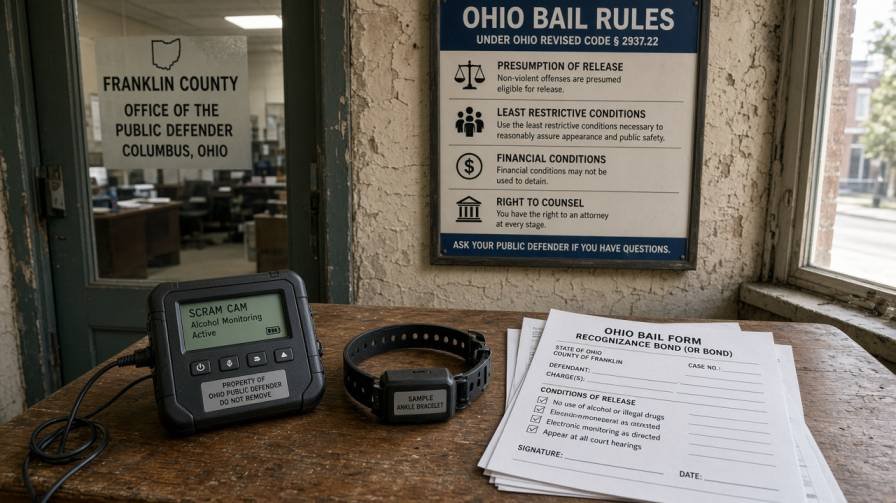
Being released from jail while a criminal case is pending does not always mean a person is free from restrictions. In Ohio, a judge can impose conditions on pretrial release that are designed to protect the community, encourage court appearances, and address risks associated with the alleged offense. When alcohol is connected to the circumstances of an arrest—particularly an OVI case—a court may impose restrictions involving alcohol use, testing, treatment, or monitoring.
Understanding these requirements is important because violating a condition of release can create additional legal problems and may affect a person’s ability to remain out of custody while the case continues.
This guide explains how alcohol monitoring can work while someone is out on bail in Ohio, what types of conditions may apply, what an alcohol-monitoring device does, and what someone should do if they are concerned about a possible violation.
Important: This article provides general information about Ohio bail and pretrial release. It is not legal advice. The specific conditions imposed on a defendant depend on the court, the charges, the defendant’s circumstances, and the wording of the release order. Anyone facing a specific case should review the actual court order with an Ohio criminal defense attorney.
What Is Alcohol Monitoring While Out on Bail?
Alcohol monitoring is a condition that can be used to determine whether a person released from custody is consuming alcohol. Depending on the court’s order, monitoring may involve scheduled alcohol tests, random testing, or continuous remote alcohol monitoring.
A continuous alcohol monitoring device is different from a traditional breath test that is performed only at a particular time. Ohio law defines “continuous alcohol monitoring” as technology capable of automatically testing and periodically transmitting alcohol-consumption levels and tamper attempts at least every hour, regardless of where the person is located.
The exact technology and procedure can vary depending on the court and monitoring program.
For someone who has been ordered not to consume alcohol, the safest approach is to treat the restriction literally: do not drink alcohol unless the court formally changes the condition.
Can an Ohio Court Require Alcohol Monitoring as a Condition of Bail?
Potentially, yes. Ohio law allows courts to impose non-financial conditions of release when those conditions are reasonably necessary to address issues such as appearance in court, public safety, or preventing obstruction of the criminal justice process.
Ohio Revised Code Chapter 2937 specifically allows courts to impose conditions that can include electronic monitoring and, in appropriate alcohol- or drug-related cases, alcohol or drug assessment and compliance with treatment recommendations.
Ohio Criminal Rule 46 also recognizes non-financial conditions of pretrial release. The rule provides that, when pretrial detention is not ordered, the court generally uses conditions intended to reasonably assure court appearance, protect people or the community, and prevent obstruction of the criminal justice process.
This means alcohol monitoring is not automatically required for every person arrested for an alcohol-related offense. It is a court-ordered condition when the circumstances and applicable law support it.
When Is Alcohol Monitoring More Likely to Be Ordered?
Alcohol-related charges are one situation in which alcohol restrictions may become particularly important.
For example, a court may consider alcohol monitoring when:
- The alleged offense involved alcohol use.
- The charge involves OVI or another alcohol-related offense.
- The court believes alcohol use may present a public-safety concern.
- A prior history of alcohol-related offenses is relevant.
- An assessment indicates that alcohol use or treatment may need to be addressed.
- The defendant has previously violated release conditions.
- The court wants an additional safeguard while the criminal case is pending.
However, there is no single statewide rule stating that every person charged with OVI must wear an alcohol monitor while on bail.
The judge’s order is critical. Two defendants facing seemingly similar charges can have different release conditions based on the facts of their cases.
What Types of Alcohol Conditions Can Be Imposed?
Alcohol-related release conditions can take different forms.
1. No Alcohol Consumption
A court may order a defendant not to possess or consume alcohol while released.
This is one of the simplest conditions, but it must still be taken seriously. A defendant should not assume that a small amount of alcohol, alcohol at a private residence, or drinking on a special occasion is acceptable unless the court order clearly permits it.
2. Random Alcohol Testing
A court or supervising agency may require alcohol testing at designated or random intervals.
The defendant may be required to report for testing, follow notification procedures, or comply with a monitoring program’s instructions.
Missing a required test can sometimes become a compliance issue even when the defendant did not consume alcohol.
3. Continuous Alcohol Monitoring
Continuous monitoring can use a wearable device to test for alcohol and communicate information to a monitoring system.
Ohio law’s definition of continuous alcohol monitoring includes automatic testing and periodic transmission of alcohol-consumption information and tamper attempts.
A defendant ordered to use such a device should understand:
- How often readings are taken.
- How the device communicates with the monitoring system.
- When the device must be charged.
- What constitutes tampering.
- What to do if the equipment malfunctions.
- Who must be contacted if there is a technical problem.
- Whether the defendant must report suspected false readings.
- Whether the device must remain on continuously.
Following the monitoring provider’s instructions is extremely important.
4. Alcohol Assessment or Treatment
Ohio law also permits certain alcohol- or drug-related release conditions involving assessment and treatment recommendations.
An assessment does not necessarily mean that a person will be ordered into residential treatment. The requirements depend on the court’s order and the assessment results.
Does an Alcohol Monitor Mean Someone Has Been Convicted?
No.
A person can be placed on pretrial release conditions while a criminal case is still pending. A release condition is not itself a conviction.
The purpose of pretrial conditions is generally to manage risks associated with release while the case proceeds. Ohio’s rules distinguish pretrial release from the later stages of a criminal case.
This distinction matters because people sometimes assume that being required to wear an alcohol monitor means the court has already determined that they are guilty. That is not necessarily the case.
The monitoring requirement is a condition of release, not a substitute for the criminal proceeding.
What Happens If an Alcohol Monitor Detects Alcohol?
A reported alcohol reading does not automatically answer every legal question.
The appropriate response depends on the monitoring system, the release order, the circumstances surrounding the reading, and the court’s procedures.
For example, a monitoring system may report a reading or possible tampering event to the supervising authority. The defendant may then need to explain what happened or respond through the appropriate legal process.
If a person believes a reading is inaccurate, the person should not simply ignore it. Instead, they should promptly follow the monitoring provider’s reporting procedure and contact their attorney.
Possible sources of concern can include:
- An unexpected monitoring alert.
- A device malfunction.
- Charging problems.
- An equipment error.
- A suspected false positive.
- A failure to follow a testing procedure.
- An allegation that the device was tampered with.
The important point is to document the problem and respond promptly rather than assuming that the issue will resolve itself.
What Counts as Tampering?
Tampering generally means interfering with the monitoring equipment or attempting to prevent it from accurately reporting information.
Depending on the device and court order, conduct that may create a problem can include removing the device without authorization, damaging it, attempting to disable it, interfering with its communication system, or otherwise violating the monitoring provider’s instructions.
Ohio law recognizes electronic monitoring technology capable of detecting certain attempts to remove, turn off, or alter monitoring equipment.
If a monitor becomes uncomfortable, damaged, loose, or otherwise appears defective, the defendant should contact the designated monitoring provider rather than attempting to repair or remove it independently.
Can Someone Be Arrested for Violating an Alcohol Monitoring Condition?
A violation of a release condition can have serious consequences.
The precise consequences depend on the court’s order and applicable Ohio law. A court may reconsider the person’s release conditions if there is an alleged violation. In some circumstances, the court may impose stricter conditions or determine that continued release is no longer appropriate.
That is why a defendant should not treat an alcohol-monitoring violation as merely a technical problem.
If you believe you may have violated a condition, contacting your criminal defense attorney promptly is generally much safer than waiting for the issue to become more serious.
What Should You Do After Being Released on Bail?
The first step is to obtain and carefully read the written release order.
Do not rely only on what you remember from the hearing.
Make a written list of every requirement, including:
- Whether alcohol consumption is prohibited.
- Whether alcohol possession is prohibited.
- Whether random testing is required.
- Whether continuous monitoring is required.
- Whether drug testing is required.
- Whether an assessment is required.
- Whether treatment is required.
- Whether there are travel restrictions.
- Whether there is a curfew.
- Whether there are required court dates or check-ins.
If anything is unclear, ask the appropriate attorney or supervising authority for clarification.
Can You Travel While Wearing an Alcohol Monitor?
That depends on the release order.
Alcohol monitoring does not necessarily mean that a person can travel anywhere without restrictions. Ohio law permits courts to place restrictions on travel, association, or place of residence as conditions of release.
Before traveling outside the permitted area, a defendant should determine whether court approval is required.
This is particularly important for overnight travel, travel outside Ohio, changes of residence, or situations that could interfere with required testing or monitoring.
What About Alcohol in Cooking, Medicine, or Everyday Products?
This is an area where assumptions can create unnecessary problems.
Different monitoring systems and court orders can have different requirements. Certain products may contain alcohol or create circumstances that require special attention.
Rather than relying on internet advice about whether a particular product is “safe,” follow the instructions provided by the monitoring program and ask the supervising authority or attorney when there is uncertainty.
The safest general rule is to avoid unnecessary exposure to products that could create a monitoring concern and to document questions before using anything that could potentially affect testing.
Alcohol Monitoring and OVI Cases in Ohio
Alcohol monitoring can be especially relevant in OVI cases.
Ohio law contains separate provisions addressing alcohol monitoring and ignition-interlock requirements in certain OVI circumstances. For example, Ohio Revised Code Section 4510.13 provides for continuous remote alcohol monitoring in specified situations involving ignition-interlock violations and certain OVI sentences.
These provisions should not be confused with every pretrial bail situation.
A person charged with OVI before trial may have release conditions established under the applicable pretrial rules and court order. A person who has already been convicted may face different statutory requirements associated with sentencing, driving privileges, ignition interlocks, or monitoring.
Because those stages are legally different, the specific paperwork and court order should always be reviewed.
Does Posting Bail Remove the Alcohol Restrictions?
No.
Posting a bond or being released through a bail bond does not automatically eliminate conditions imposed by the court.
A bail bond helps secure the defendant’s release according to the terms established by the court. The defendant remains responsible for complying with the release conditions.
For example, someone may be released after a surety bond is posted but still be required to:
- Avoid alcohol.
- Submit to testing.
- Wear an alcohol monitor.
- Attend an assessment.
- Follow treatment recommendations.
- Appear at scheduled hearings.
- Follow travel or contact restrictions.
The release conditions remain important after the person leaves jail.
What If the Bail Conditions Seem Too Strict or Impossible to Follow?
Do not simply disregard them.
If a condition creates a genuine problem—for example, a work schedule conflicts with required testing—the appropriate approach is to ask the court or attorney about obtaining a lawful modification.
A defendant should not unilaterally decide that a condition is unreasonable and stop complying.
The court’s written order controls unless it is properly changed.
Frequently Asked Questions
Is alcohol monitoring automatically required for everyone released on bail in Ohio?
No. Alcohol monitoring is not automatically imposed on every person released on bail. Conditions depend on the court, the charges, the facts of the case, and applicable law.
Can you drink alcohol while out on bail?
If the release order prohibits alcohol, you should not drink. If the wording is unclear, obtain clarification before consuming alcohol.
How long does alcohol monitoring last?
There is no single period that applies to every pretrial defendant. The duration depends on the court’s order and the applicable circumstances.
Can an alcohol monitor detect alcohol immediately?
Monitoring technology is designed to detect and report alcohol according to the specifications of the particular system. The exact operation depends on the device and monitoring program.
What should I do if my alcohol monitor gives an unexpected alert?
Follow the monitoring provider’s instructions, document what happened, and contact your attorney promptly if the alert could result in a violation allegation.
Can a bail bondsman remove an alcohol-monitoring requirement?
Generally, a bail bond agency does not have authority to change a court-ordered condition. Questions about modifying a judicial release condition should be directed through the appropriate legal process.
