
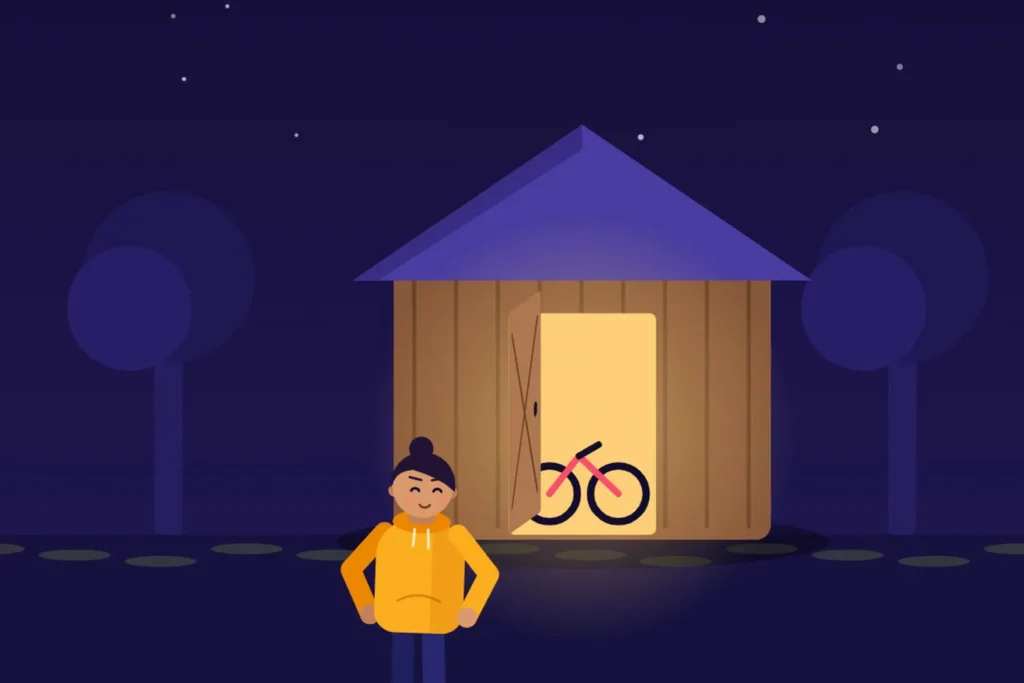
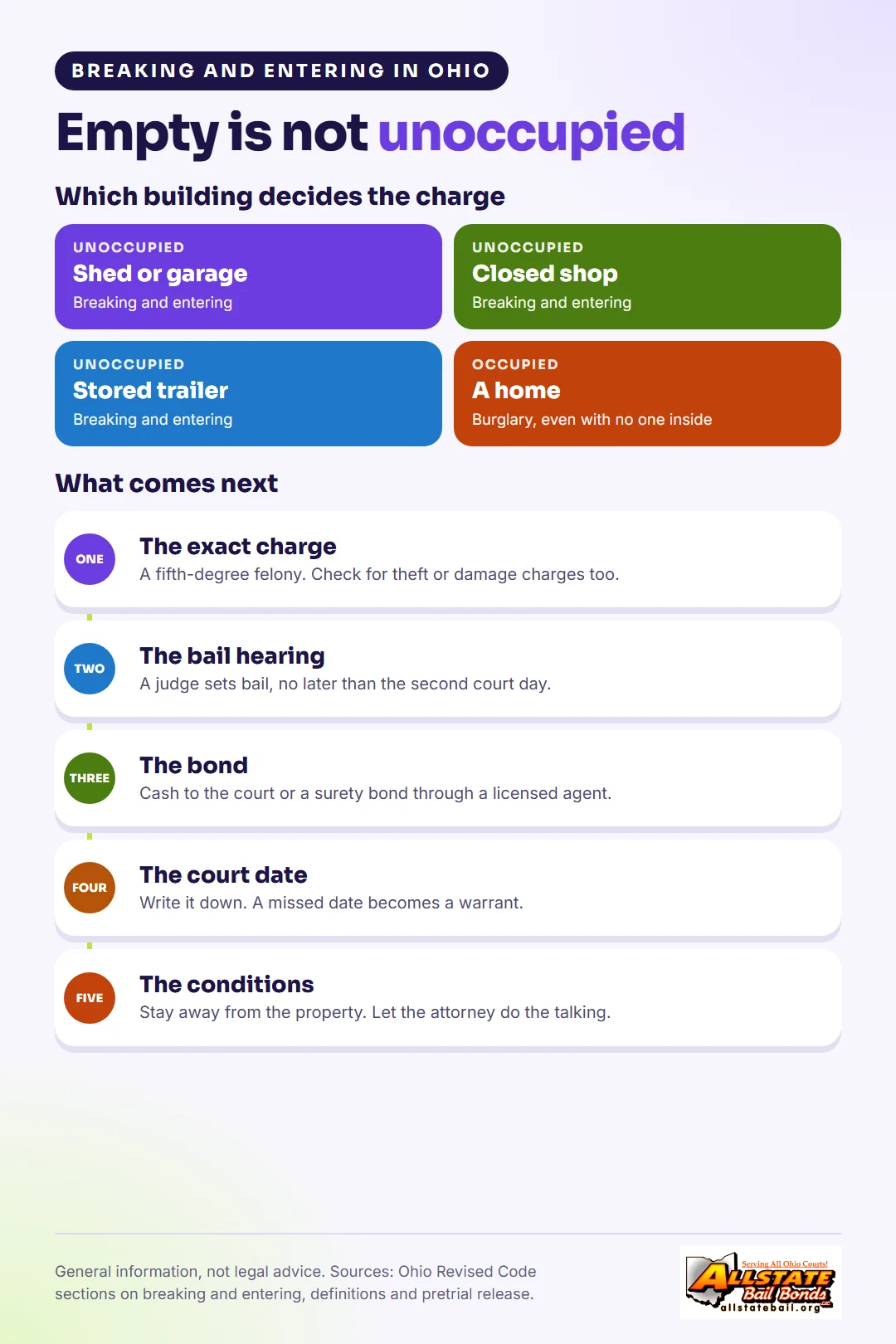
Quick answer: in Ohio, breaking and entering means getting into an unoccupied structure by force, stealth or deception with the purpose of committing a theft offense or a felony inside. It is a fifth-degree felony. Because it is a felony, bail is normally set by a judge at a hearing rather than taken from a schedule, and for a person who is held, that hearing should happen no later than the second court day after the arrest. Once bail is set, it can be paid in cash or posted through a licensed bail agent as a surety bond.
Many families hear the words “breaking and entering” and picture a smashed window. The law is broader than that, and one word in it matters more than any other: unoccupied. This guide explains what that word means, how the charge differs from burglary, and what to expect from the first call to the first court date.
In this guide
- What the law says
- Empty is not the same as unoccupied
- Force, stealth or deception
- How serious is it?
- How bail works on this charge
- After release
- When a bail bondsman is needed
- Frequently asked questions
What the law says
R.C. 2911.13 describes two ways to commit breaking and entering:
| Part of the law | What it covers |
|---|---|
| Division (A) | Trespassing in an unoccupied structure by force, stealth or deception, with the purpose of committing a theft offense or any felony inside |
| Division (B) | Trespassing on the land or premises of another with the purpose of committing a felony |
Two things have to come together: the way the person got in, and the purpose they had. Being somewhere without permission, with no such purpose, is usually criminal trespass instead, which is a misdemeanor.
Empty is not the same as unoccupied
This is where most of the confusion starts. A building can be empty tonight and still be an occupied structure in the eyes of the law. Ohio’s definition in R.C. 2909.01 treats a home that someone keeps as a dwelling as occupied even when that person is away. Getting into that kind of building can lead to a burglary charge, which is more serious.
| Usually unoccupied (breaking and entering) | Can be occupied (burglary) |
|---|---|
| A shed or a detached garage | A house, even when the family is out |
| A store or office after closing | An apartment, even between visits |
| A storage unit or a warehouse | A cabin or second home kept for living in |
| A stored, winterized trailer | A place where someone is present or likely to be |
The Ohio Supreme Court looked at this question in State v. Fazenbaker (2020) and treated a covered, winterized travel trailer in storage as an unoccupied structure. Every building is judged on its own facts, so the label on the complaint is where a family should start.
Force, stealth or deception
Nothing has to be broken. Ohio courts have read “force” to include very little effort, such as opening a closed door. Stealth means getting in secretly, and deception means getting in through a lie or a false pretense. Each of those can satisfy the law on its own.
How serious is it?
- Breaking and entering is a fifth-degree felony, the lowest of Ohio’s felony levels, but still a felony.
- Burglary, R.C. 2911.12, applies to occupied structures and carries higher felony levels.
- Criminal trespass, R.C. 2911.21, is the misdemeanor when there was no purpose to commit a crime inside.
The same night can be charged in different ways depending on the building and what prosecutors believe the purpose was, and theft or damage charges are often filed alongside it. Read every charge on the paperwork. Lawmakers have also proposed changes to this group of offenses, so ask a defense attorney about the version of the law that applies to your case.
How bail works on this charge
Under R.C. 2937.011, misdemeanor bail can come from a court schedule, but a felony like breaking and entering usually waits for a judge. For a person who has not been released, the law calls for an initial bail hearing no later than the second court day after the arrest. The judge decides the amount and any conditions, such as staying away from the property or from the people involved.
Before you call anyone, ask the facility three things: the exact charges, whether a bail hearing has been held or scheduled, and whether any other court has a hold. No one outside the court can tell you in advance what a judge will decide or how long release steps will take.
After release
- Read the conditions. Staying away from the property is a common one. Breaking it can bring a new charge and put the bond at risk.
- Do not go back to explain or to return anything. Let the defense attorney handle contact with the owner.
- Write down the court date. A missed date on a felony case means a warrant.
- Keep the papers together. The complaint, the bond paperwork and every notice from the court.
When a bail bondsman is needed
Once a judge sets bail, the family can pay the full amount in cash to the court or work with a licensed bail agent on a surety bond. The agent verifies where the person is held and the bail on each charge, explains the cash and surety options, and handles the paperwork and the posting of the bond.
Have this ready when you call: the person’s full legal name and date of birth, the county, the charges, whether bail is set, and your own phone number. Ohio surety bail bond agents are licensed through the Ohio Department of Insurance. Our list of questions to ask the jail covers the rest.
Frequently asked questions
What is breaking and entering in Ohio?
Under R.C. 2911.13, it is using force, stealth or deception to trespass in an unoccupied structure with the purpose of committing a theft offense or any felony inside. It also covers trespassing on someone else’s land or premises with the purpose of committing a felony.
Is breaking and entering a felony in Ohio?
Yes. Breaking and entering is a fifth-degree felony, the lowest felony level in Ohio. Because it is a felony, bail is usually decided by a judge rather than taken from a misdemeanor schedule.
Does something have to be broken for a breaking and entering charge?
No. The statute says force, stealth or deception. Force can be as small as opening a closed door, and stealth or deception means nothing has to be damaged at all.
What is the difference between breaking and entering and burglary?
The main difference is the building. Breaking and entering is about an unoccupied structure, such as a shed, a detached garage or a closed business. Burglary involves an occupied structure, which can include a home even when no one is inside at the moment. Burglary is the more serious charge.
Can a garage, shed or storage unit count?
Often, yes. Structures where no one lives or is likely to be present are the usual setting for this charge. The Ohio Supreme Court has even treated a winterized, stored travel trailer as an unoccupied structure. The facts of each building matter.
Can I post bail right away on a breaking and entering charge?
Usually not from a schedule. On a felony, a judge typically sets bail at a hearing, and for a person who is held, R.C. 2937.011 calls for that hearing no later than the second court day after the arrest. Once bail is set, it can be paid in cash or posted through a licensed bail agent.
Reach a licensed bail bondsman any time
Allstate Bail Bonds serves all Ohio courts day and night, all year, including holidays. A licensed local bondsman can verify where your family member is held and whether bail has been set, explain your options and handle the paperwork and bond posting. Find your nearest office on our Ohio locations page, including Paulding, Defiance and Lima.
About the author: Allstate Bail Bonds has served Ohio courts since 2007. The company is owned by Drew Evans, a licensed Ohio bail agent (license #724711). This article is general information for defendants and families, not legal advice. The statutes have detailed definitions and every case turns on its own facts, so confirm the charge and dates with the court and speak with a defense attorney about your case. Last reviewed November 2026.
Sources: Ohio Revised Code 2911.13 (breaking and entering), 2909.01 (definitions, occupied structure), 2911.12 (burglary), 2911.21 (criminal trespass), 2937.011 (pretrial release and bail); State v. Fazenbaker, Supreme Court of Ohio, 2020; Ohio Department of Insurance.
