
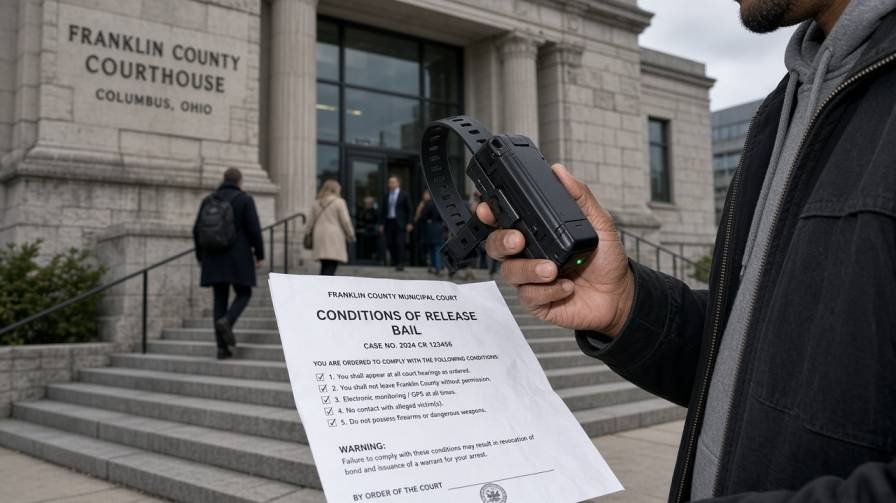
When someone is arrested in Ohio, getting released from jail does not always mean being free of restrictions. Depending on the circumstances of the case, a court may impose specific bail conditions, including electronic monitoring, house arrest, travel restrictions, no-contact orders, drug or alcohol treatment, or other requirements designed to help ensure the person appears in court and does not pose a safety risk.
Understanding how electronic monitoring works and what is expected after release can help defendants and their families avoid preventable violations. Bail conditions are court orders, and failing to follow them can have serious consequences.
This guide explains electronic monitoring and bail conditions in Ohio, how GPS monitoring may work, what defendants should do after release, common problems that can lead to violations, and how a bail bond agency can help families understand the release process.
Important: This article provides general information about Ohio bail and pretrial release procedures. It is not legal advice. Bail conditions can vary by court, county, case, and individual circumstances. For advice about a specific criminal case, speak with a qualified Ohio attorney and follow the instructions of the court and supervising agency.
What Is Electronic Monitoring in Ohio?
Electronic monitoring is a system used to monitor a person’s location or compliance with court-ordered restrictions while the person is released from custody.
Ohio law specifically allows a court to impose electronic monitoring or house arrest as a condition of pretrial release. Ohio Revised Code Section 2937.011 provides that, unless detention is ordered under applicable law, a defendant who is entitled to release should generally be released under the least restrictive conditions that reasonably assure court appearance, community safety, and protection of the criminal justice process. The statute also specifically lists electronic monitoring and house arrest among possible release conditions.
Electronic monitoring can involve technology capable of determining a person’s location at particular times or continuously, depending on the type of system being used. Ohio law recognizes electronic monitoring devices that can identify a person’s location and detect certain attempts to turn off, alter, or tamper with the device.
The exact monitoring requirements depend on the court order and the agency responsible for supervision.
Why Would a Court Require Electronic Monitoring?
Electronic monitoring can provide an alternative to keeping someone in jail while still imposing restrictions intended to protect the community and encourage compliance with court requirements.
A court may consider factors such as:
- The seriousness and circumstances of the alleged offense
- The person’s history and prior court appearances
- Potential risks to victims or the community
- The likelihood of appearing for future court dates
- Whether restrictions on travel or residence are appropriate
- Whether additional supervision is necessary
- Whether other conditions of release can reasonably address the court’s concerns
Ohio’s pretrial release statute provides that release conditions should reasonably assure appearance in court, protect people and the community, and prevent obstruction of the criminal justice process. It also permits restrictions involving travel, association, residence, victim contact, and electronic monitoring.
Electronic monitoring therefore does not necessarily mean that a person has been convicted or sentenced. In some situations, it is a pretrial release condition imposed while a criminal case is still pending.
What Is a GPS Ankle Monitor?
One common form of electronic monitoring is a GPS-enabled ankle device.
A GPS monitoring system may allow an authorized monitoring agency to determine a person’s location and identify whether the person enters or leaves designated areas. Depending on the court’s requirements and the monitoring program, there may be approved locations, restricted areas, curfews, or other geographic limitations.
The device itself is not the court order. The court’s release conditions are what determine what the defendant is required to do.
For example, a person may be ordered to:
- Remain at an approved residence
- Follow a specific curfew
- Stay away from a protected person’s residence or workplace
- Avoid certain geographic areas
- Travel only for approved employment or medical appointments
- Attend court hearings
- Report to a supervising agency
- Comply with additional conditions imposed by the court
The exact requirements must be confirmed from the applicable court order and instructions provided by the supervising authority.
Electronic Monitoring Is Not the Same as Bail
A common misunderstanding is that posting bail automatically means a person can go wherever they want until the next court date.
That is not necessarily the case.
Bail is related to release from custody and the conditions established by the court. Electronic monitoring is one possible condition of release.
For example, a court could order release with a financial bond and electronic monitoring. Another defendant might be released under different conditions without electronic monitoring. Ohio law permits several forms of bail and allows courts to impose additional conditions when legally appropriate.
This distinction matters because satisfying the financial portion of a bond does not eliminate other court-ordered requirements.
A person released on bond may still have to comply with monitoring, court dates, travel restrictions, no-contact provisions, treatment requirements, or other conditions.
What Happens After Electronic Monitoring Is Ordered?
The process can vary depending on the county, court, and monitoring program.
Generally, the defendant will receive instructions regarding the monitoring device and the conditions that must be followed. The monitoring authority may establish approved locations, reporting requirements, curfews, or other restrictions.
Before leaving custody, it is important to understand:
- Where you are permitted to live.
- When you are allowed to leave your residence.
- Which locations are restricted.
- Whether employment travel is approved.
- Whether medical appointments require authorization.
- How court appearances should be handled.
- How to report technical problems.
- What actions could be considered tampering.
- Who should be contacted if an emergency affects compliance.
Do not assume that something is permitted simply because it seems reasonable. If the court or monitoring agency has imposed a restriction, obtain clarification before violating it.
Common Electronic Monitoring Problems
Electronic monitoring can create practical challenges, especially for people who are unfamiliar with the equipment or restrictions.
1. Battery or Charging Problems
Some monitoring equipment requires regular charging. Allowing the battery to become depleted can create an alert or compliance issue.
A defendant should understand the charging instructions immediately after receiving the device and make charging part of their daily routine.
2. Travel Confusion
A person may believe they are allowed to travel somewhere for work, school, medical care, or another important reason. However, if the location or travel period has not been authorized, leaving the permitted area could potentially create a violation.
When uncertain, contact the supervising authority before traveling.
3. Curfew Violations
A defendant may have a specific time by which they must return to an approved residence.
Traffic, work delays, family emergencies, or other unexpected events do not automatically change a court-ordered curfew. If an emergency occurs, document the situation and contact the appropriate supervising authority as soon as possible.
4. Equipment Damage or Tampering
Ohio law recognizes monitoring devices capable of detecting unauthorized removal, alteration, or tampering.
Never attempt to remove, disable, modify, damage, or interfere with a monitoring device unless specifically authorized by the responsible authority.
If the device appears damaged or malfunctions, report the problem promptly rather than attempting to repair it yourself.
5. Address Changes
Moving to a different residence without authorization can create problems when the residence is part of the court’s release conditions.
If a change in housing becomes necessary, ask the supervising authority or attorney what approval is required before moving.
What Should You Do If the Monitor Malfunctions?
Technical problems should be treated seriously.
If a device displays an error, stops functioning, loses power, becomes damaged, or appears to be malfunctioning:
- Follow the monitoring provider’s instructions.
- Contact the designated monitoring authority promptly.
- Keep records of calls or communications.
- Follow any troubleshooting instructions provided.
- Do not remove or alter the device yourself.
- Contact your attorney if the problem could affect compliance.
Documentation can be especially important when an unexpected technical problem occurs.
The safest approach is to report a problem rather than ignore it.
Can Bail Conditions Be Changed?
Possibly, but a defendant should not assume that conditions can simply be changed informally.
If circumstances change—for example, a defendant changes employment, needs a different residence, has a medical issue, or has another legitimate reason that conflicts with an existing restriction—an attorney can explain whether a formal request to modify the conditions is appropriate.
The court controls the release conditions. A bail bond agency cannot simply cancel a court-ordered restriction.
This is one reason defendants should keep copies of their release paperwork and understand exactly what the court has ordered.
What Happens If Someone Violates a Bail Condition?
The consequences depend on the nature of the alleged violation and the applicable court orders and laws.
A violation could result in additional court proceedings and may affect the person’s continued release. In some circumstances, the court can modify release conditions or take other action permitted by law.
For example, electronic monitoring may be one part of a broader release plan. Violating the monitoring requirement, failing to appear in court, contacting a protected person when prohibited, or leaving an approved area can create separate problems.
The safest strategy is straightforward: know the conditions, follow them carefully, and ask for clarification before taking an action that could conflict with the order.
How Families Can Help Someone on Electronic Monitoring
Family members can play an important practical role in helping a defendant comply with release conditions.
They can help by:
- Keeping a copy of important court information.
- Helping the defendant track court dates.
- Encouraging compliance with curfews.
- Avoiding situations that could cause accidental contact with protected individuals.
- Helping maintain reliable transportation.
- Reminding the defendant about appointments and reporting requirements.
- Encouraging prompt communication with the monitoring authority when problems arise.
Family support cannot replace legal advice or supervision, but good organization can reduce avoidable mistakes.
How a Bail Bond Agency Can Help
When someone is arrested, families often have questions about the bond amount, release process, paperwork, and what happens after a bond is posted.
A licensed bail bond agency can explain the bail-bond process and help families understand the practical steps involved in arranging a bond. However, court-ordered conditions remain the responsibility of the defendant and are controlled by the court and appropriate supervising authorities.
If electronic monitoring has been ordered, a bail bond agent should not be viewed as a substitute for the court, monitoring agency, or defense attorney.
The best approach is to make sure everyone understands their respective responsibilities.
Frequently Asked Questions
Does electronic monitoring mean someone has been convicted?
No. Electronic monitoring can be imposed as a condition of pretrial release, meaning it may apply while a criminal case is still pending.
Can I leave my home while wearing a GPS monitor?
Not necessarily. Your ability to leave depends on the specific conditions imposed by the court and the instructions of the supervising authority.
Can I go to work while on electronic monitoring?
Possibly, if employment travel is permitted under the release conditions. Do not assume that work automatically creates an exception to a geographic restriction or curfew.
What should I do if my monitor is not working?
Contact the designated monitoring authority promptly and follow its instructions. Do not attempt to remove or modify the device yourself.
Can a bail bondsman change my electronic monitoring requirements?
Generally, court-ordered conditions are controlled by the court. A bail bond agency can assist with the bond process but should not be treated as the authority that modifies judicial release conditions.
What if I need a change in my bail conditions?
Speak with your attorney about whether a request to modify the conditions should be made to the court. Do not simply ignore an existing restriction.
